
Article Content
Hydrogen sulfide (H₂S) is a highly toxic, corrosive gas commonly present in natural gas, associated gas, and multiphase production streams. Removing it is essential for safety, pipeline specifications (often <4–10 ppmv H₂S), corrosion control, and environmental compliance. Liquid chemical scavengers — most commonly triazine-based formulations — are a popular non-regenerative option for low-to-moderate H₂S levels (typically <200–500 ppmv). These are applied via two primary methods: direct injection into pipelines or flowlines, and bubble columns (also called contactor towers, sparged towers, or flooded contactors).
This article provides a rigorous, step-by-step methodology to calculate the required scavenger volume or mass for a given gas stream. It is based on stoichiometric principles, industry rule-of-thumb efficiencies, mass-transfer considerations, and practical design guidelines from field data and modeling. The focus is on MEA Triazine (the most common liquid scavenger), but the framework applies to other liquid chemistries (e.g., glyoxal blends, non-triazine organics) by substituting their specific capacities.
1. Understanding the Chemistry and Theoretical Capacity
The dominant liquid scavenger is 1,3,5-tris(2-hydroxyethyl)-1,3,5-triazinane (HET or MEA-triazine), formed from monoethanolamine (MEA) and formaldehyde.
Reaction stoichiometry (simplified two-step process):
- 1 mol HET + 2 mol H₂S → dithiazine (main byproduct) + 2 mol ethanolamine (released)
Molecular weights:
- HET: C₉H₂₁N₃O₃ ≈ 219.28 g/mol
- H₂S: 34.08 g/mol
Therefore, 219.28 g pure HET theoretically removes 68.16 g H₂S.
Theoretical capacity:
- Pure HET: 3.22 kg HET per kg H₂S removed (or 0.311 kg H₂S per kg pure HET).
- Commercial products are aqueous solutions, typically 30–50% active. For a standard 40 wt% MEA-triazine: Theoretical: 8.05 kg solution per kg H₂S.
Other liquid scavengers (e.g., glyoxal-based or advanced non-triazine blends) have different capacities — always obtain the vendor’s lab-derived uptake (kg scavenger/kg H₂S at 100% utilization) or use a blend calculator based on active components.
Note: The reaction is irreversible under normal conditions but sensitive to pH (>7 preferred), temperature (faster kinetics at higher T), and excess H₂S (can lead to polymeric byproducts and solids).
2. Step 1: Calculate the H₂S Mass or Molar Load in the Gas Stream
You need the daily (or hourly) mass of H₂S to be removed.
Inputs:
- Gas flow rate, Q (standard volume units, e.g., MMscfd or Nm³/h or Sm³/day)
- Inlet H₂S concentration, C (ppmv or mol%)
- Target outlet H₂S (if partial removal; usually assume full removal to spec)
- Standard conditions (confirm basis: usually 15°C/101.325 kPa or 60°F/14.696 psia)
Conversion formulas (using US customary units for common oilfield practice):
H₂S mass flow rate (lb/day) = Q (MMscfd) × C (ppmv) × 0.0898
(Where 0.0898 lb H₂S/day per MMscfd per ppmv derives from 1 MMscfd ≈ 2,635.7 lb-mol/day gas; 1 ppmv = 10⁻⁶ mol fraction; H₂S MW = 34.08 lb/lb-mol.)
Metric equivalent (approximate):
H₂S (kg/h) ≈ [Q (Sm³/h) × C (ppmv) × 34.08] / (22.414 × 10⁶) (using 22.414 m³/kmol at 0°C; adjust for 15°C standard if needed ≈ 23.64 m³/kmol → factor ~0.00144 kg/h per Sm³/h per ppmv)
Example baseline: 10 MMscfd gas with 50 ppmv H₂S → H₂S load ≈ 10 × 50 × 0.0898 = 44.9 lb/day (≈ 20.4 kg/day).
Account for:
- Pressure and temperature effects on actual volumetric flow if not already standardized.
- Water saturation (scavengers perform best in wet gas).
- Partial removal if only reducing to a target spec.
3. Step 2: Determine Theoretical Scavenger Requirement
Theoretical scavenger mass (or volume) = H₂S mass load × Theoretical factor
For 40% MEA-triazine: 8.05 kg scavenger solution per kg H₂S.
Convert to volume using product density (typically 1.05–1.15 sg for triazine solutions → ~8.8–9.6 lb/gal).
Example continuation: 20.4 kg/day H₂S × 8.05 kg/kg = 164 kg/day scavenger (≈ 40–45 gal/day at typical density).
4. Step 3: Apply Practical Utilization (Efficiency) Factor
Field performance is lower than theoretical due to mass-transfer limitations, incomplete reaction, side reactions, and mixing inefficiencies.
Industry rule-of-thumb utilization (from extensive field data on triazine systems):
- Direct injection: 40–50% utilization → multiply theoretical by 2.0–2.5 (i.e., use 2–2.5× the stoichiometric amount).
- Bubble columns / contactor towers: 70–80%+ utilization → multiply theoretical by 1.25–1.43.
These factors already incorporate typical over-dosing margins. Vendors may provide lab bottle tests or field-derived capacities (e.g., 0.5–0.8 lb H₂S removed per gallon of 40% triazine in towers vs. 0.3–0.5 lb/gal in direct injection).
Advanced modeling (e.g., GTI’s semi-empirical pipeline model) can refine this for specific conditions.
Adjusted example:
- Direct injection (50% util.): 164 kg/day / 0.5 = 328 kg/day (~80–90 gal/day).
- Bubble column (80% util.): 164 kg/day / 0.8 = 205 kg/day (~50 gal/day).
For batch bubble columns, this is the daily replenishment rate once the initial inventory is spent. Monitor spent scavenger pH or H₂S breakthrough to schedule replacement.
5. Method-Specific Considerations and Additional Design Steps
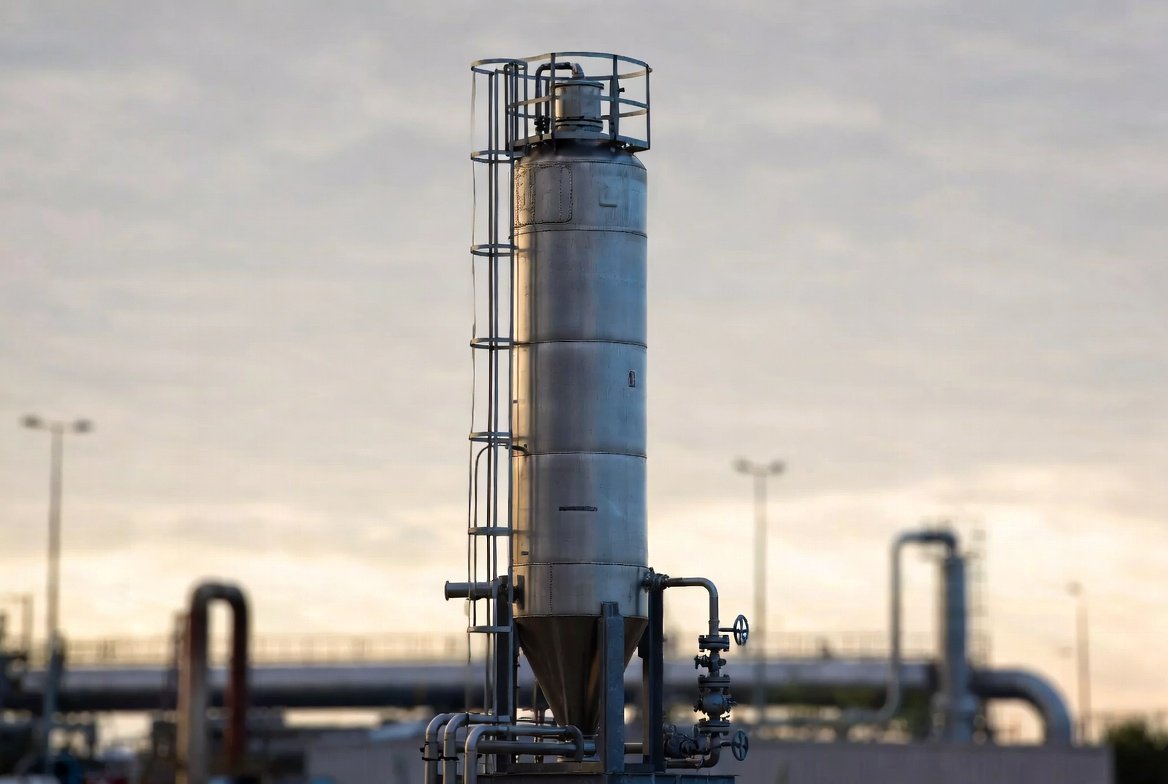
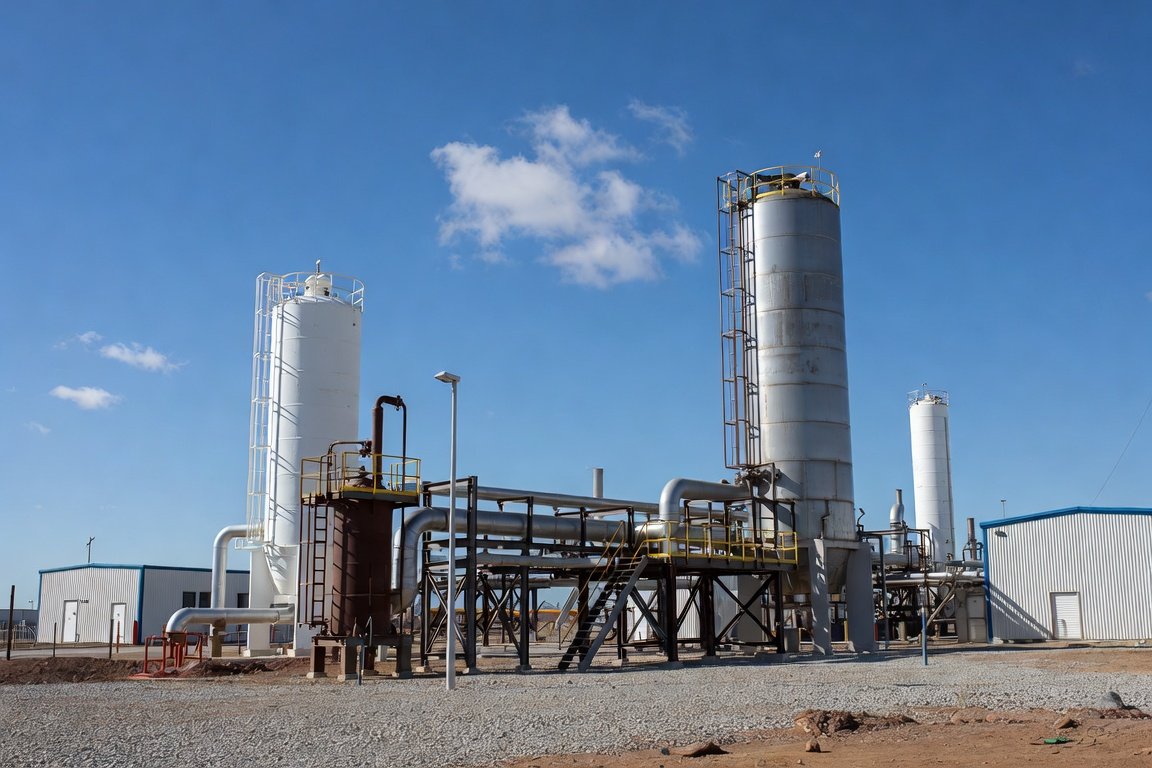
Bubble Columns (Contactor Towers / Sparged Towers)
This method provides intimate, long-contact gas-liquid interaction by bubbling gas upward through a static or slowly circulating inventory of liquid scavenger.
Additional design steps for scavenger quantity and system sizing:
- Determine tower inventory volume: Base on gas flow and desired residence time/liquid height. Typical liquid height: 3–6 m (10–20 ft). Tower diameter sized for superficial gas velocity < 0.15–0.3 m/s (0.5–1 ft/s) to avoid flooding or excessive entrainment.
- Sparger design: Perforated pipe or diffuser for fine bubbles (increases interfacial area). Finer bubbles improve kinetics but risk foaming.
- Contact time: Gas bubbles spend 10–60+ seconds in liquid, enabling high utilization (80%+).
- Scavenger management: Usually batch — fill tower with calculated initial volume (inventory + daily consumption buffer). Drain/replace when outlet H₂S rises or solids appear. Some designs allow continuous top-up and bleed-off.
- Efficiency advantage: Up to 2× better chemical utilization than direct injection; ideal for onshore, steady-flow applications with space available.
- Limitations: Not suited for very high gas rates (>50–100 MMscfd without multiple towers) or offshore (weight/footprint). Potential foaming or solids buildup requires monitoring.
Scavenger calculation refinement: Use the 80% utilization baseline, but validate with vendor pilot data for your gas composition (CO₂ can slightly increase consumption).
Direct Injection
Scavenger is atomized via quill, nozzle, or static mixer directly into the gas pipeline. Reaction occurs in the flowing pipe segment, followed by a separator/knockout to remove spent liquid.
Additional design steps:
- Injection point and mixing: Use atomizing quill or nozzle for fine droplets. Locate upstream of a long, preferably upward-sloping pipe section.
- Residence (contact) time: Minimum 15–20 seconds recommended (longer = better). Calculate required pipe length: L (ft) = velocity (ft/s) × time (s). Higher velocity and smaller diameter improve performance (more wall wetting and interfacial area).
- Pipe configuration: Single large pipe works but multi-pipe parallel bundles (e.g., 3–6 smaller lines) dramatically improve efficiency via higher surface-to-volume ratio and better turndown.
- Flow regime: Target annular-mist or high-velocity dispersed flow; avoid stratified low-velocity flow.
- Utilization: Apply 50% (or 2–5× stoichiometric in conservative cases). Field data often shows 1.8–2.5 gal 40% triazine per lb H₂S removed in well-designed systems.
- Separator: Downstream knockout drum or scrubber to capture spent scavenger and prevent liquid carryover.
- Modeling refinement: Use mass-transfer-based simulators (e.g., solving dY_H2S/dz = –(K a P / G) Y_H2S along pipe length) incorporating kinetics, solubility, droplet size, and hydrodynamics. Key variables: pressure (higher P improves), temperature (optimal ~100–120°F), CO₂ level (increases consumption), water content.
Advantages: Low CAPEX, offshore-friendly, quick retrofit.
Challenges: Lower efficiency, risk of under-dosing (H₂S breakthrough) or over-dosing (waste, solids), sensitivity to flow variations.
6. Full Worked Example
Case: 25 MMscfd natural gas, 80 ppmv H₂S, target <4 ppmv (assume ~95% removal → effective load 76 ppmv equivalent). Use 40% MEA-triazine, density 9.2 lb/gal.
- H₂S load: 25 × 76 × 0.0898 ≈ 170.6 lb/day H₂S (77.4 kg/day).
- Theoretical (40% triazine): 77.4 × 8.05 ≈ 623 kg/day.
- Bubble column: At 80% util. → 623 / 0.8 = 779 kg/day ≈ 185 gal/day replenishment. Tower inventory: e.g., 500–1,000 gal depending on size.
- Direct injection: At 50% util. → 623 / 0.5 = 1,246 kg/day ≈ 296 gal/day. Requires ~200–500 ft of suitable pipe (velocity-dependent) + good atomization.
Adjust ±20–30% based on field trials and real-time H₂S monitoring (automated dosing with feedback is best practice).
7. Key Factors Affecting Dosage and Optimization Tips
- Gas composition: High CO₂ increases consumption (competes for alkalinity). Oxygen or low water content can cause solids.
- Operating conditions: Higher pressure/temperature generally better; low T slows kinetics.
- Over-dosing margin: Start at calculated rate +20%, monitor outlet H₂S, and trim.
- Byproduct management: Spent scavenger is water-soluble but can form solids if over-saturated; dispose per regulations (high aquatic toxicity if unreacted triazine remains).
- Monitoring: Continuous H₂S analyzers upstream/downstream + pH or residual scavenger tests on spent liquid.
- Alternatives/hybrids: Direct injection upstream of a small bubble column for polishing; multi-pipe direct injection for large flows.
- Cost considerations: Bubble columns have higher CAPEX but much lower OPEX (30–60% less chemical). Direct injection is cheaper to install but higher ongoing cost.
Always validate calculations with vendor lab tests on your specific gas and scavenger batch, followed by field trials. Sophisticated CFD or process simulators can further optimize for complex pipelines.
Safety note: H₂S is lethal at low concentrations — use proper PPE, H₂S monitors, and follow lockout/tagout during scavenger handling (triazine can cause skin burns).
By following these steps, operators can accurately predict and minimize scavenger consumption while ensuring reliable H₂S removal. Proper system design tailored to the application method yields the best economics and performance. Consult specialized engineering firms or vendors for site-specific modeling.