Article Content
Direct injection of liquid H₂S scavengers (such as MEA-triazine or non-triazine alternatives) is one of the most cost-effective ways to remove low concentrations of hydrogen sulfide from natural gas streams. When done correctly, an atomizing nozzle for H2S scavenger injection dramatically improves contact efficiency, reduces chemical usage, and helps pipelines meet strict <4 ppmv H₂S specs.
This comprehensive 2026 guide walks you through exactly how to select and size the right atomizing nozzle for direct injection into flowing natural gas pipelines — whether you’re dealing with gathering lines, transmission pipelines, or upstream processing.
When Should You Use an Atomizing Nozzle for H2S Scavenger Injection?
Simple injection quills or tees work in high-velocity pipelines, but an atomizing nozzle becomes essential when gas velocity drops below 20 ft/s, contact length is short, or pipe diameter is large.
Benefits of proper atomization include:
- Up to 10x more gas-liquid interfacial area for faster H₂S reaction
- Better pipe-wall wetting in stratified flow
- Reduced liquid dropout and pooling
- Lower overall scavenger consumption (often 10–30% savings)
In many field trials, operators who switched to properly sized atomizing nozzles achieved consistent <4 ppm outlet H₂S with 15–25% less chemical.
Types of Atomizing Nozzles for Natural Gas Pipeline Scavenger Injection
Here’s a quick comparison of the two main types used in the industry:
| Type | Best For | Droplet Size (SMD) | Pros | Cons |
|---|---|---|---|---|
| Hydraulic (Pressure) Atomizing (Full-cone or hollow-cone) |
Most pipeline applications (500–1500 psig) | 100–250 μm | Simple, no external gas needed, reliable | Requires higher ΔP for fine mist |
| Twin-Fluid (Air/Steam Assisted) | Low-velocity lines or ultra-fine mist needed | 30–100 μm | Finest droplets even at low liquid pressure | Requires air/nitrogen/steam supply |
Popular models: BETE MicroWhirl® & XA series, Spraying Systems FloMax® & WhirlJet®, Lechler precision lances.
Key Factors for Selecting the Right Scavenger Injection Nozzle
Before sizing, gather this data:
- Scavenger flow rate (gpm)
- Available pressure drop across nozzle (typically 100–300 psi)
- Pipeline ID, gas velocity, pressure & temperature
- Liquid properties (viscosity 5–50 cP for most scavengers)
- Desired droplet size (target 50–200 μm for optimal entrainment)
- Installation constraints (retractable lance, port size)
Step-by-Step: How to Size an Atomizing Nozzle for H2S Scavenger Injection
- Calculate Required Scavenger Flow Rate
Formula: Gallons/day = (MMscfd × ppm H₂S removed × factor) / scavenger capacity.
Typical range: 0.5–3 gal/MMscf. Convert to gpm. - Determine Available ΔP
Pump discharge pressure – pipeline pressure – line losses. Target 100–200 psi for best atomization. - Select Nozzle Model & Orifice Size
Use manufacturer catalogs (BETE, Spraying Systems, Lechler). Flow rate Q ∝ √ΔP. Choose model that delivers exact gpm at your ΔP with SMD in 50–200 μm range. - Verify Spray Coverage & Entrainment
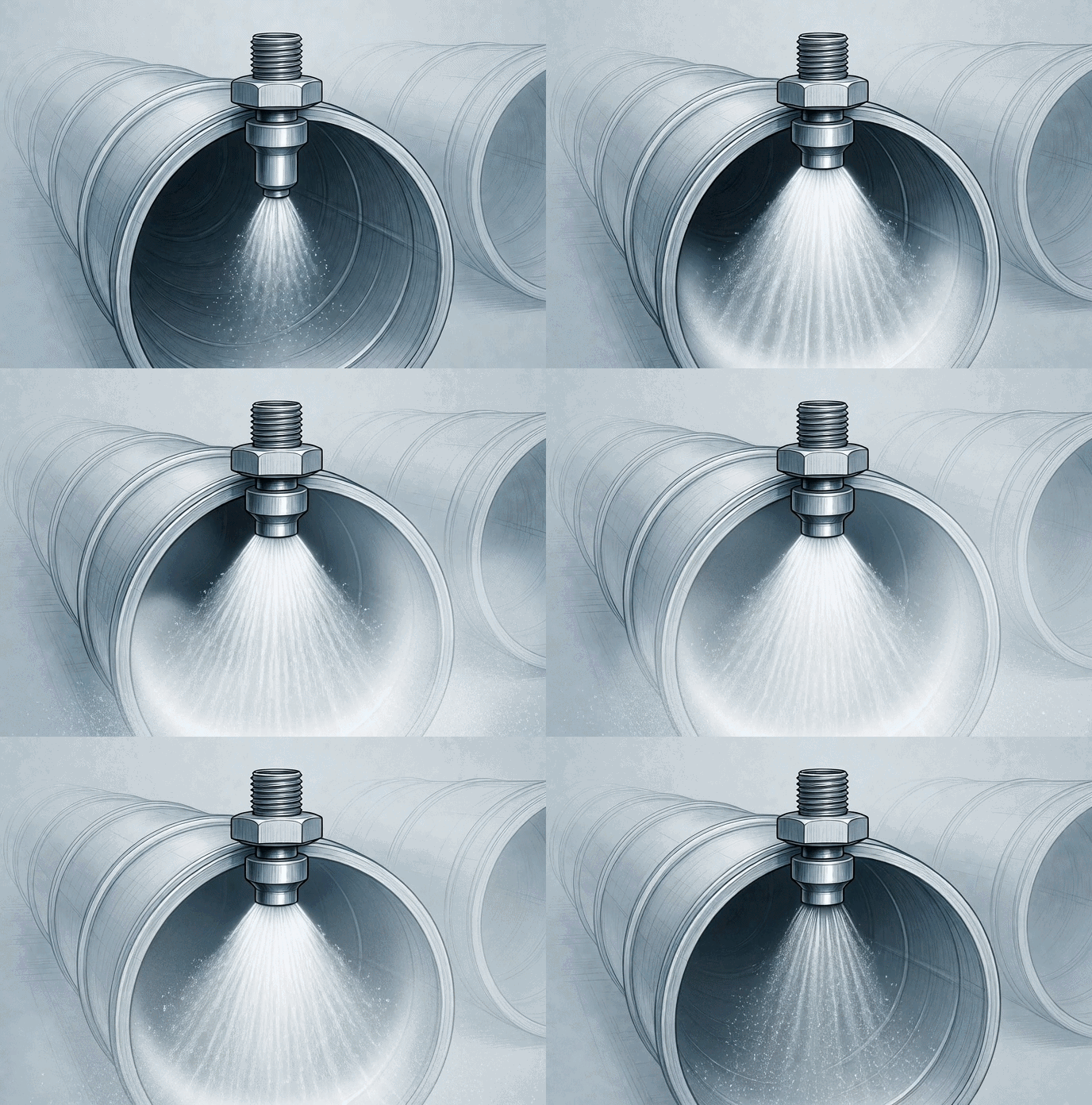
60–90° full-cone pattern. Ensure lance reaches pipe centerline. Minimum 3D upstream straight pipe, 8–10D downstream. - Specify Materials & Accessories
316SS standard; Hastelloy for severe service. Add upstream filter and optional retractable lance. - Field Validation
Start at calculated rate, sample downstream H₂S, and fine-tune.
Best Practices & Common Mistakes to Avoid
- Install in horizontal or upward-flow pipe sections
- Use cleanable or quick-swap designs to prevent plugging
- Never oversize the nozzle — insufficient ΔP = poor atomization
- Consider multiple injection points for very large pipes
- Always install a strainer upstream
Real-World Sizing Example
5 MMscfd gas, 8-inch pipeline, 100 ppm H₂S removal, 0.01 gpm scavenger required, 150 psi available ΔP.
Recommended nozzle: BETE full-cone hydraulic model delivering 0.01 gpm at 150 psi with ~120 μm SMD and 60° spray angle.
Result: Excellent droplet entrainment at 25 ft/s gas velocity and consistent H₂S removal below 4 ppm.
FAQ – Atomizing Nozzles for H2S Scavenger Injection
Do I really need an atomizing nozzle or is a quill enough?
A simple quill is often adequate above 20–30 ft/s gas velocity. Below that, or with short contact length, an atomizing nozzle for H2S scavenger injection is strongly recommended.
What is the ideal droplet size for scavenger injection?
Target Sauter Mean Diameter (SMD) of 50–200 μm. Finer droplets increase surface area but must stay entrained by gas velocity.
Can I use air-assisted nozzles in natural gas service?
Yes — twin-fluid nozzles using nitrogen or plant air are excellent for low-velocity pipelines and provide the finest mist.
How often should I inspect or clean the nozzle?
Every 3–6 months or at the first sign of increased chemical consumption. Retractable lances make this easy without shutdown.
Which manufacturers are best for pipeline scavenger nozzles?
BETE, Spraying Systems Co., and Lechler are the industry leaders with proven track records in H₂S scavenger applications.
Conclusion: Get the Right Atomizing Nozzle and Save Money
Selecting and sizing the correct atomizing nozzle for H2S scavenger injection is one of the highest-ROI decisions in natural gas pipeline treating. Proper atomization maximizes contact efficiency, lowers chemical costs, reduces corrosion risk, and ensures regulatory compliance.
Need help with your specific pipeline conditions? Share your flow rate, pressure, pipe size, and H₂S loading — our team (or your nozzle supplier) can provide a free sizing recommendation within 24 hours.