Article Content
Liquid H2S scavenger—primarily triazine-based chemistries like MEA or MMA triazine—offer a non-regenerative, cost-effective solution for low-to-moderate H₂S concentrations. However, the application method dramatically influences overall efficiency, chemical consumption, and operational costs.
This article examines typical efficiencies achieved with common H₂S scavenger deployment techniques: direct injection via quill, direct injection via atomizing nozzle, co-current bubble columns, and counter-current bubble columns. We also detail the key operating parameters that affect performance in each method. Data is drawn from field experience, GTI/Trimeric modeling studies, and operator case histories. For deeper dives into optimization strategies, see our related articles: Optimizing H2S Scavengers in Direct Injection and Benefits and Drawbacks of Direct Injection of Liquid Scavengers into Gas Pipelines.
1. Direct Injection via Quill
Direct injection via quill is one of the simplest and lowest-CAPEX methods for H₂S scavenging. A quill (typically a ¼-inch or ½-inch open-ended tube) injects liquid scavenger directly into the gas or multiphase flowline. The chemical is carried downstream by the gas stream, where it reacts with dissolved H₂S.
Typical Efficiencies: Real-world removal efficiencies hover around 40% under standard conditions. Utilization (pounds of H₂S removed per gallon of scavenger) is often 40-50% of theoretical stoichiometry. Operators frequently report needing 2–5 times the stoichiometric dose to meet outlet specifications (e.g., <4 ppmv H₂S). Poor dispersion causes much of the scavenger to fall out of the gas stream and pool at the pipe bottom, rendering it ineffective.
In poorly designed single large-diameter pipes, efficiencies can drop below 30%. Optimized multi-pipe configurations with proper contact length have achieved <4 ppmv outlet specs using approximately 1.8 gallons of triazine per pound of H₂S removed—still far below tower-based systems.
Key Parameters Affecting Efficiency
- Pipe Diameter & Flow Regime: Larger diameters (>12 in) promote stratified flow at low velocities, reducing wetted surface area. Target annular-mist flow (10–50 ft/s velocity) for maximum gas-liquid contact.
- Gas Velocity & Contact Time: Minimum 15–20 seconds residence time required; 30–60+ seconds is optimal. Short contact in gathering lines often necessitates retention loops or extended piping.
- Pressure & Temperature: Higher pressures improve H₂S solubility into the scavenger. Optimal temperature range is 60–120°F; extremes slow kinetics or degrade byproducts.
- Injection Location & Pipe Geometry: Upstream wellhead injection leverages longer gathering lines. Upward pipe inclination increases liquid holdup and mass transfer.
- CO₂ Content & Water Saturation: CO₂ competes for scavenger capacity. Dry gas requires water addition to prevent solid dithiazine precipitation.
Quill injection shines in low-CAPEX, variable-flow scenarios but demands careful modeling. For a full playbook on reducing chemical consumption, read Optimizing H2S Scavengers Direct Injection.
2. Direct Injection via Atomizing Nozzle
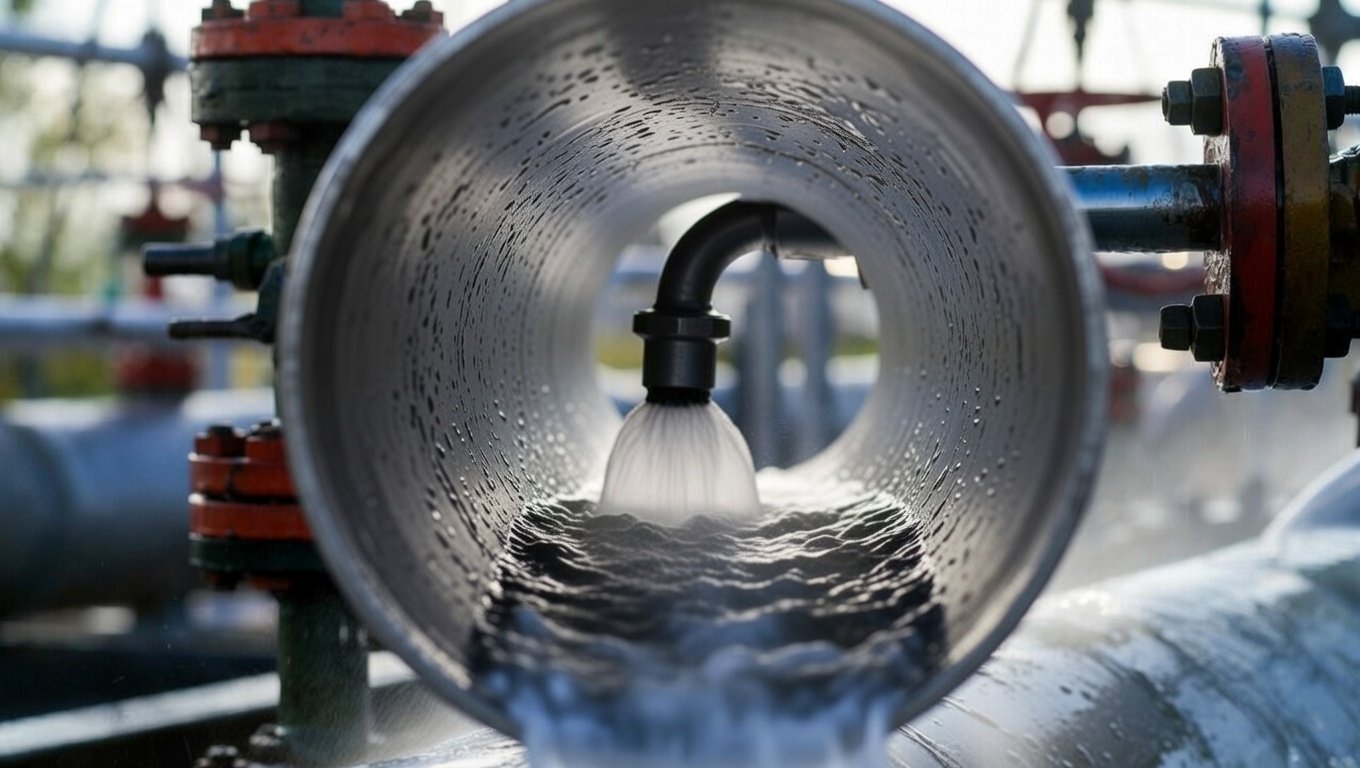
Atomizing nozzles represent a significant upgrade over simple quills. These specialized injectors (often BETE or proprietary designs) break the scavenger into fine droplets (25–100 microns), dramatically increasing interfacial surface area and improving dispersion throughout the gas stream.
Typical Efficiencies: Efficiencies improve to 40–80% depending on design and conditions—often 1.5–2× better than quill-only systems. In CFD-validated studies and field trials, properly sized atomizing nozzles have reduced scavenger consumption by 30–50% while achieving the same outlet H₂S specification. Multi-pipe systems with atomizing nozzles routinely meet <4 ppmv targets at near-stoichiometric rates (≈1.8 gal/lb H₂S).
Atomization is particularly beneficial in short-contact or low-velocity scenarios where quills fail due to droplet coalescence and fallout.
Key Parameters Affecting Efficiency
- Droplet Size & Nozzle Design: Smaller droplets increase surface area but risk evaporation or carryover. Nozzle orientation (co- or counter-flow) and spray pattern must match gas velocity.
- Gas Flow Rate & Velocity: Atomizers excel where quills struggle—at lower velocities or in large-diameter lines. Pulsation dampeners ensure consistent spray.
- Contact Length & Mixing: Even with atomization, 500+ ft of downstream pipe or static mixers enhance performance.
- Pressure Drop & Plugging: Nozzles can plug with solids or byproducts; filtration and proper chemistry selection (e.g., MMA triazine for better solubility) mitigate this.
- System Turndown: Multi-pipe parallel configurations maintain optimal velocity and droplet distribution across varying flows.
CFD simulations confirm that atomizing nozzles outperform quills in particle survival and distribution, especially in turbulent flow. For implementation guidance, see our case studies on direct injection benefits and drawbacks.
3. Co-Current Bubble Column (Dynamic Contactor)
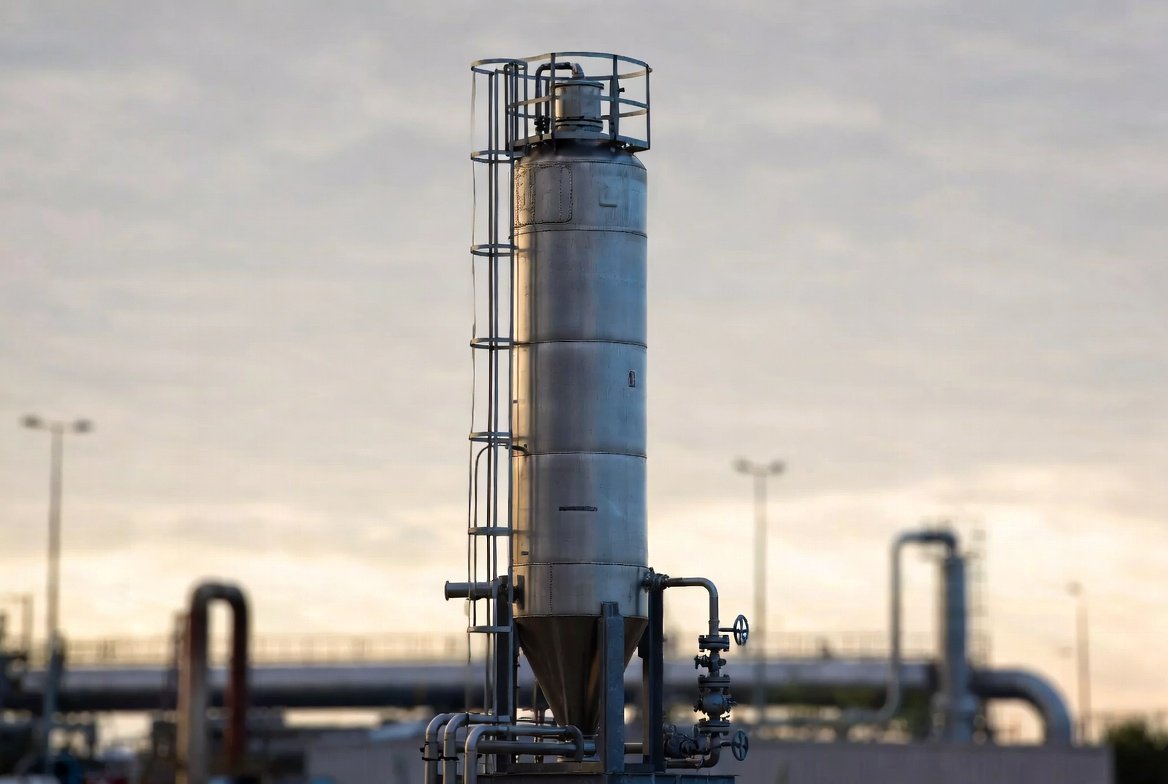
Co-current bubble columns—also called scavenger towers, H₂S scrubbers, or flooded dynamic contactors—are continuous-flow vessels where both gas and liquid scavenger enter at the bottom and flow upward together before separation in a downstream knockout drum. Gas bubbles through a continuous liquid phase, creating intimate contact.
Typical Efficiencies: Well-designed co-current systems achieve 70–85% H₂S removal efficiency (or utilization) with triazine scavengers. Some optimized installations reach 80–95% when inlet H₂S is low-to-moderate (<500 ppm). Chemical consumption can approach 1.5–2.0 gal/lb H₂S—significantly better than direct injection.
These towers are favored in North American operations for their balance of efficiency, footprint, and ease of operation.
Key Parameters Affecting Efficiency
- Gas & Liquid Velocities (G/L Ratio): Optimal superficial gas velocity prevents flooding while maximizing bubble holdup. Typical G/L ratios are tuned via level control.
- Column Height & Liquid Holdup: Taller columns (20–40 ft) provide longer residence time (10–60 seconds). Liquid level directly controls contact time.
- Sparger/Bubble Size: Fine-bubble spargers (e.g., sintered metal or perforated plates) increase interfacial area. Smaller bubbles = higher mass transfer coefficient (kLa).
- Temperature & Pressure: 60–120°F and moderate pressure enhance solubility and reaction kinetics without excessive byproduct formation.
- Scavenger Concentration & pH: Fresh scavenger concentration (typically 20–40 wt%) and buffering affect reaction rate and capacity.
Co-current operation is mechanically simple but offers slightly lower driving force than counter-current designs. For a complete comparison of bubble column types, visit Enhance H2S Removal with Innovative Bubble Column Types.
4. Counter-Current Bubble Column
In counter-current systems, gas enters at the bottom and flows upward while scavenger is introduced at the top and flows downward. The vessel often doubles as a separator, with spent scavenger withdrawn from the bottom. This configuration maximizes the concentration gradient (driving force) for mass transfer throughout the column.
Typical Efficiencies: Counter-current bubble columns routinely deliver 80–95%+ removal efficiency, often outperforming co-current designs by 10–20% in the same footprint. Utilization can exceed 85–98% of theoretical capacity in optimized installations, with some non-triazine chemistries reaching near-stoichiometric performance. Outlet H₂S levels below 1–4 ppmv are common even at higher inlet concentrations.
The superior mass transfer makes counter-current the preferred choice for tighter specifications or higher H₂S loads.
Key Parameters Affecting Efficiency
- Counter-Flow Dynamics: Opposite flow directions create a more uniform driving force, reducing the required column height for equivalent removal.
- Liquid Holdup & Level Control: Precise level control (via automated loops) maintains optimal liquid residence time and prevents flooding or gas breakthrough.
- Gas Velocity vs. Liquid Downflow: Must stay below flooding velocity. Higher liquid rates improve scrubbing but increase pressure drop.
- Sparger Design & Bubble Regime: Homogeneous bubbling regime (small, uniform bubbles) is ideal; heterogeneous regimes reduce efficiency.
- Operating Conditions: Same temperature/pressure sweet spot as co-current, but counter-current tolerates slightly higher CO₂ interference due to staged contact.
- Column Geometry: Diameter-to-height ratio and internals (if any) influence back-mixing and efficiency.
Counter-current operation generally provides higher overall mass transfer efficiency than co-current, as confirmed by mechanistic models of bubble-column hydrodynamics.
Comparative Overview & Selection Guidelines
Here is a quick comparison table (typical values for triazine-based scavengers):
| Method | Typical Efficiency | Chemical Utilization | CAPEX | Best For |
|---|---|---|---|---|
| Quill Direct Injection | ~40% | 40–50% of stoich. | Very Low | Low H₂S, short-term, variable flow |
| Atomizing Nozzle Injection | 40–80% | 60–80% of stoich. | Low | Moderate H₂S, existing pipelines |
| Co-Current Bubble Column | 70–85% | 70–85% of stoich. | Medium | Continuous treatment, North American ops |
| Counter-Current Bubble Column | 80–95%+ | 80–98% of stoich. | Medium | Tight specs, higher H₂S loads |
Selection depends on inlet H₂S concentration, flow rate variability, footprint constraints, and OPEX targets. Direct injection suits <500 ppm H₂S and low CAPEX budgets, while bubble columns excel for consistent, high-efficiency treatment. Hybrid approaches (injection + polishing tower) are increasingly common.
Additional factors influencing all methods include real-time H₂S monitoring, automated dosing, and scavenger chemistry selection (non-triazine options can boost performance in multiphase or high-temperature service). For a broader overview of H₂S removal technologies, explore our guide on top H2S removal methods at fklaz.com.
Conclusion: Optimizing for Maximum Efficiency
Application method is the single largest lever for H₂S scavenger performance. While direct injection via quill offers simplicity at ~40% efficiency, upgrading to atomizing nozzles or shifting to bubble columns can double or triple utilization rates. Understanding site-specific parameters—contact time, flow regime, temperature, geometry, and chemistry—allows operators to minimize chemical spend, reduce downtime, and meet stringent specifications reliably.