Article Content
Ultraviolet (UV) disinfection has become a cornerstone of modern water treatment, offering a chemical-free, rapid, and highly effective method to inactivate harmful microorganisms. While widely used for general disinfection in drinking water, wastewater, and industrial applications, UV technology plays a particularly valuable role in controlling sulfate-reducing bacteria (SRB) that generate hydrogen sulfide (H₂S)—the compound responsible for the notorious “rotten egg” odor, corrosion, and operational issues in wells, distribution systems, and oilfield waters.
This in-depth article explores the fundamentals of UV water treatment, its broad applications, and its specific effectiveness against SRB, drawing on established science, regulatory guidelines, and real-world implementations.
The Fundamentals of UV Disinfection: How It Works
UV light occupies the electromagnetic spectrum between visible light and X-rays, with germicidal effects concentrated in the UV-C band (200–280 nm). The optimal wavelength for disinfection is approximately 254 nm, produced by low-pressure mercury vapor lamps (the same principle as fluorescent bulbs). At this wavelength, UV photons penetrate the cell walls of microorganisms and are absorbed by their nucleic acids (DNA and RNA).
The primary mechanism is the formation of thymine dimers—covalent bonds between adjacent thymine bases in DNA strands. These dimers distort the DNA helix, blocking replication and transcription. As a result, the microorganism cannot reproduce or carry out essential cellular functions and eventually dies. This process inactivates rather than physically removes the microbes; the dead cells remain in the water but pose no infection risk.
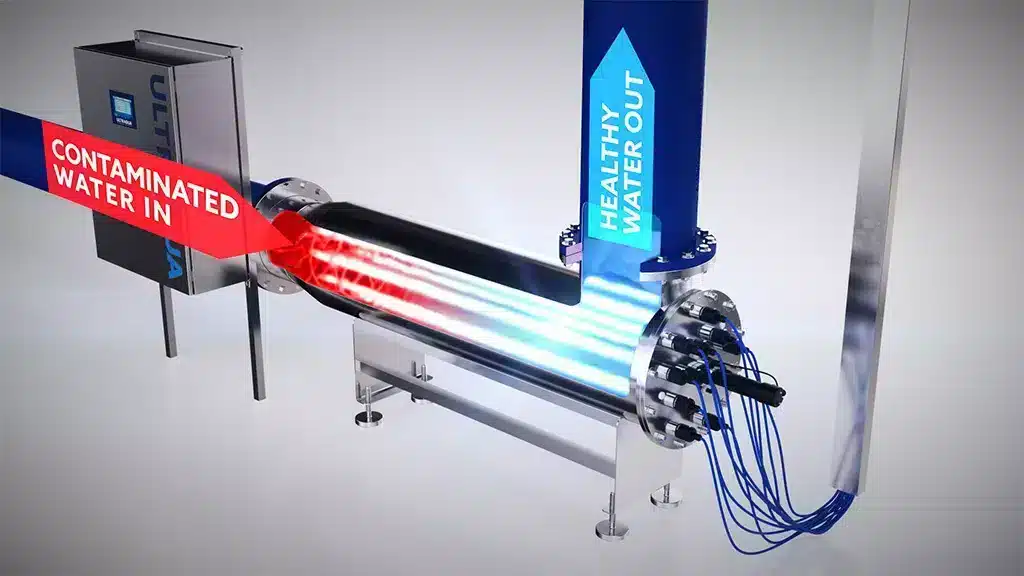

Typical UV System Components
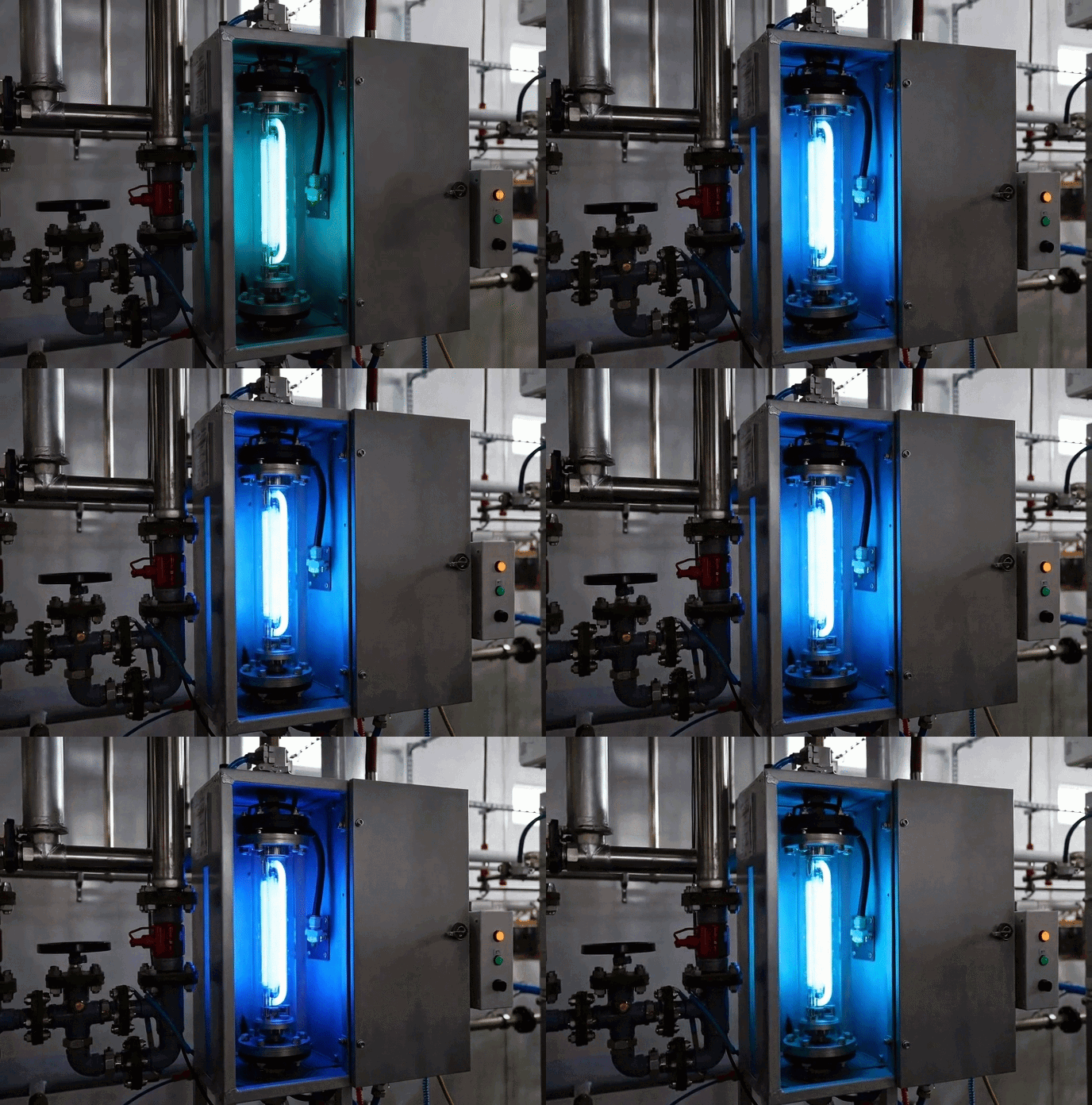
- UV Lamp: Low-pressure (LP) or medium-pressure (MP) mercury lamps emit the 254 nm light. Newer UV-LED systems (peaking at ~265 nm) are emerging as mercury-free alternatives.
- Quartz Sleeve: A protective transparent tube around the lamp that allows UV transmission while isolating the lamp from water.
- Reactor Chamber: Usually stainless steel, designed for turbulent flow to ensure all water particles receive adequate exposure.
- Ballast and Controls: Regulate power, monitor UV intensity (via sensors), and trigger alarms or shutdowns if dosage drops.
- Wipers (optional): Automatic or manual cleaning to prevent fouling on the sleeve.
Water flows through the chamber in seconds, receiving a UV dose (fluence) measured in mJ/cm² (millijoules per square centimeter). Dose = intensity (mW/cm²) × exposure time (s). Standard systems deliver 30–40 mJ/cm² or more for 4-log (99.99%) inactivation of most bacteria.
UV effectiveness depends on:
- UV Transmittance (UVT) of the water (typically >85–90% required; turbidity, iron, manganese, or organics reduce it).
- Flow rate (must match system sizing).
- Lamp age and cleanliness (lamps are replaced annually after ~9,000 hours).
General Applications and Effectiveness in Water Treatment
UV is approved by the U.S. EPA for small public water systems and is a best available technology for Cryptosporidium and Giardia control (unlike chlorine). It achieves:
- Bacteria (e.g., E. coli, coliforms): 4-log reduction at ~10–20 mJ/cm².
- Viruses: 4-log at 90–140 mJ/cm².
- Protozoa (Giardia, Cryptosporidium): Highly effective at 10–40 mJ/cm² with validated systems.
Key Applications
- Municipal drinking water (often combined with chlorine for residual protection).
- Private wells and point-of-entry (POE) residential systems.
- Wastewater effluent polishing.
- Bottled water, food/beverage processing, pharmaceuticals, and swimming pools.
- Industrial process water and cooling towers.
Advantages
- Chemical-free: No addition of chlorine, ozone, or biocides; no disinfection by-products (DBPs) like trihalomethanes.
- Rapid: Seconds of contact time vs. minutes for chemicals.
- No taste, odor, or pH change.
- Environmentally friendly: Low energy use, minimal waste (lamp disposal is the main consideration).
- Effective against chlorine-resistant pathogens.
Limitations
- No residual disinfection—microbes can regrow downstream without a secondary barrier (e.g., chloramine).
- Requires pre-filtration for turbid or iron-rich water (UVT must be high).
- Power-dependent; systems include alarms and bypass prevention.
- Does not remove dissolved chemicals, minerals, or existing organics/H₂S.
Maintenance is straightforward: annual lamp replacement, periodic sleeve cleaning, and UV intensity monitoring. Certified systems meet standards like NSF/ANSI 55 Class A (40 mJ/cm² minimum for clear water).
Hydrogen Sulfide and Sulfate-Reducing Bacteria: The Problem
H₂S is a toxic, corrosive gas with a low odor threshold (~0.5 ppm). In water, it causes rotten-egg smells, metallic taste, black staining, and accelerated corrosion of pipes, heaters, and infrastructure. Concentrations above 1–2 ppm are noticeable and problematic; levels can reach 10–75 ppm in affected wells.
While H₂S can form chemically (e.g., from sulfate in anaerobic groundwater reacting with metals), the primary biological source is sulfate-reducing bacteria (SRB). These anaerobic heterotrophs (e.g., Desulfovibrio desulfuricans, Desulfovibrio vulgaris, and over 220 strains) use sulfate (SO₄²⁻) as an electron acceptor, producing H₂S as a metabolic byproduct:
SO₄²⁻ + organic carbon → H₂S + CO₂ + biomass
SRB thrive in low-oxygen environments: deep wells, stagnant plumbing, water heaters (hot side), biofilms in softeners, distribution dead-ends, and oil reservoirs. They contribute to microbiologically influenced corrosion (MIC), reservoir souring in oil & gas, and biofilm formation that shields other pathogens.
How UV Eliminates SRB and Controls H₂S Production
UV directly inactivates SRB by the same DNA-damage mechanism effective against other bacteria. SRB are highly sensitive to UV-C at 254 nm.
Key Evidence and Performance:
- Standard drinking-water doses of 40 mJ/cm² achieve >4-log (>99.99%) reduction of SRB in a single pass (~0.5 seconds exposure).
- Laboratory studies confirm significant reductions in viable cells, turbidity, and corrosion rates.
- Pilot trials in oilfield injection waters validate UV against target SRB species.
Why UV Excels for SRB Control:
- No resistance: Unlike chemical biocides, microbes cannot develop immunity to UV-induced DNA damage.
- Chemical-free: Avoids biocide storage hazards and environmental issues.
- Targeted prevention: Kills SRB before they produce more H₂S and form protective biofilms.
- Rapid and continuous: Effective in anaerobic conditions once water passes through the reactor.
Important Caveat: UV does not remove or oxidize existing dissolved H₂S. It stops future bacterial production but requires complementary steps (aeration, oxidation with chlorine/peroxide, or specialized media) for immediate odor removal.
Real-World Applications and Integration
Oil & Gas
Seawater lift and produced-water re-injection: UV systems replace or reduce biocide use, cutting costs, footprint, and environmental impact.
Residential/Well Water
Multi-barrier approach: Sediment filter → aeration/oxidation for H₂S removal → activated carbon → UV disinfection to kill SRB and other bacteria.
Best Practices
- Pre-treatment: Ensure UVT >90% with filters.
- Sizing: Match flow rate and dose to water quality testing.
- Monitoring: UV intensity sensors, flow meters, alarms.
- Maintenance: Lamp replacement yearly; sleeve cleaning; annual water testing.
Future Trends
- UV-LEDs: Mercury-free, instant-on, wavelength-tunable.
- Hybrid Systems: UV + AOP for simultaneous disinfection and chemical destruction.
- Smart Controls: IoT monitoring for predictive maintenance.
Conclusion
UV disinfection represents one of the most elegant and sustainable solutions in water treatment—leveraging physics rather than chemistry to render pathogens harmless. For SRB specifically, UV provides a powerful, resistance-proof tool to eliminate the biological source of H₂S, preventing odor, corrosion, and operational headaches in wells, pipelines, and industrial systems.
When integrated into a multi-barrier treatment train with appropriate pre- and post-treatment, UV delivers safe, odor-free water reliably and cost-effectively. As technology advances with LEDs and smarter systems, UV’s role in safeguarding water resources will only expand.
For specific system recommendations, consult certified water professionals and test your source water thoroughly.
Sources: EPA guidelines, NSF/ANSI standards, Ultraaqua, Xylem, peer-reviewed studies on SRB disinfection. Images used under fair-use / public licensing for educational purposes and are hotlinked directly for automatic display.