Article Content
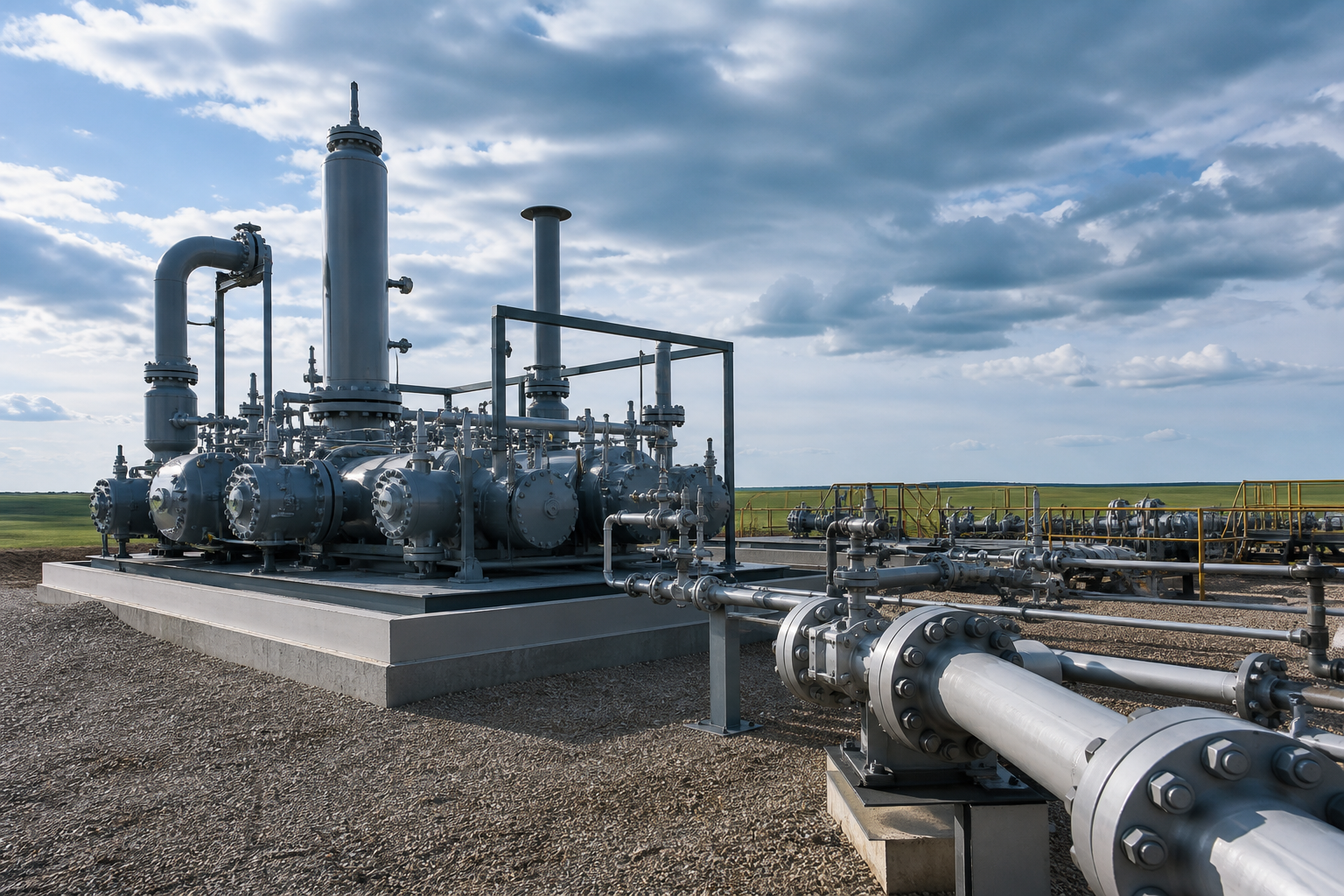
Removing H₂S — a process known as gas sweetening — is non-negotiable for operators worldwide. While regenerative amine systems (using aqueous monoethanolamine or MDEA) dominate high-volume, high-H₂S fields, liquid chemical scavengers offer a flexible, lower-capex alternative for moderate H₂S levels, remote locations, declining fields, or as a polishing step. Among these, MEA and MMA triazine scavengers have become the industry standard since the late 1980s.
Two leading triazine formulations stand out: MEA Triazine (monoethanolamine-based) and MMA Triazine (monomethylamine-based). Although they share a similar hexahydro-s-triazine core structure and comparable H₂S uptake, their differences in byproduct behavior, temperature tolerance, environmental profile, and operational reliability make the choice between them highly application-specific.
This article provides a detailed, data-driven comparison to help engineers, operators, and procurement teams select the optimal scavenger for their natural gas operations.
1. Manufacturing of MEA and MMA Triazine
How MEA Triazine is Produced
MEA Triazine (chemical name: hexahydro-1,3,5-tris(2-hydroxyethyl)-s-triazine, CAS 4719-04-4) is manufactured by the controlled condensation reaction of three moles of monoethanolamine (MEA) with three moles of formaldehyde under mildly alkaline conditions. The exothermic reaction forms a stable six-membered triazine ring with three hydroxyethyl substituents.
The process requires precise temperature control (typically 40–70°C) and pH management. Commercial products are usually supplied as 70–80% active aqueous solutions (sometimes with excess MEA as solvent/stabilizer). The high active content makes MEA Triazine one of the most concentrated liquid scavengers available.
How MMA Triazine is Produced
MMA Triazine (hexahydro-1,3,5-trimethyl-s-triazine, CAS 108-74-7) follows an analogous synthesis route but uses monomethylamine (CH₃NH₂) instead of monoethanolamine. Three moles of MMA react with three moles of formaldehyde to yield the trimethyl-substituted triazine ring.
Because monomethylamine is more volatile and the resulting molecule less polar, commercial formulations are often supplied at lower active concentrations (commonly 40% w/w) in water.
2. Physical and Chemical Properties
| Property | MEA Triazine (78%) | MMA Triazine (40%) |
|---|---|---|
| CAS Number | 4719-04-4 | 108-74-7 |
| Active Content | 70–80% w/w | ~40% w/w |
| Primary Solvent | Water + excess MEA | Water + MMA |
| pH (neat) | 9.5 – 11.0 | 9.5 – 10.5 |
| Freezing Point | < –5 °C | < –15 °C |
| BTEX Content | Trace (standard grade) | None (BTEX-free) |
| Solubility | Highly water-soluble; good hydrocarbon miscibility | Water-soluble; byproducts more oil-soluble |
| Viscosity | Moderate to high | Lower |
Table 1: Key physical and chemical specifications of commercial MEA and MMA Triazine formulations.
3. H₂S Scavenging Mechanism and Uptake Capacity
Both scavengers operate via an irreversible nucleophilic substitution reaction. The triazine ring opens and reacts with H₂S to form stable dithiazine compounds, permanently sequestering the sulfur.
Stoichiometric uptake capacity for both products is approximately 1.0–1.2 lb H₂S per US gallon of formulated scavenger. In practice, field efficiency reaches 70–80% of theoretical (0.7–0.96 lb H₂S/gal), limited by contact time, mixing efficiency, temperature, and H₂S loading rate.
Key difference:
- MEA Triazine forms 5-hydroxyethyldithiazine, which can precipitate as solids and cause fouling.
- MMA Triazine forms methyl dithiazine, which is oil-soluble and significantly reduces solids and fouling problems.
Optimal temperature: 80–120 °F (27–49 °C). MEA efficiency drops more sharply in cold conditions, while MMA performs better across a wider temperature range.
4. When and How to Apply Each Scavenger in Natural Gas Operations
Both products are deployed in two primary configurations:
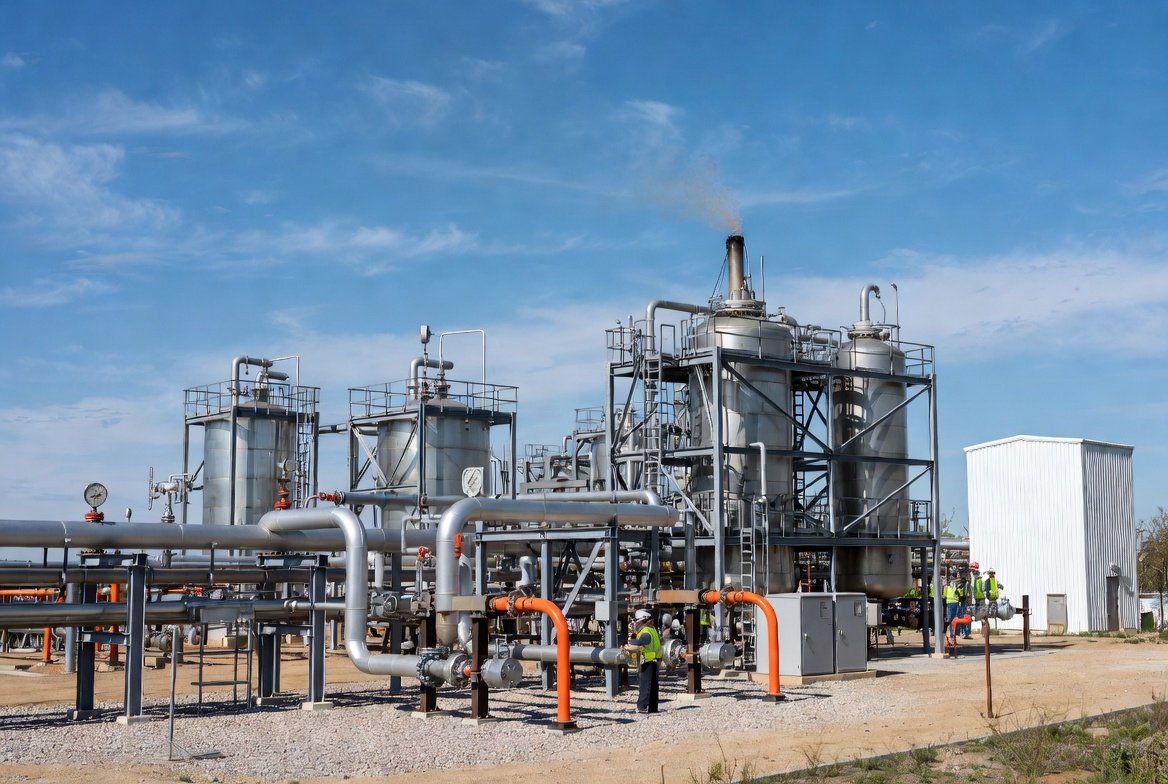
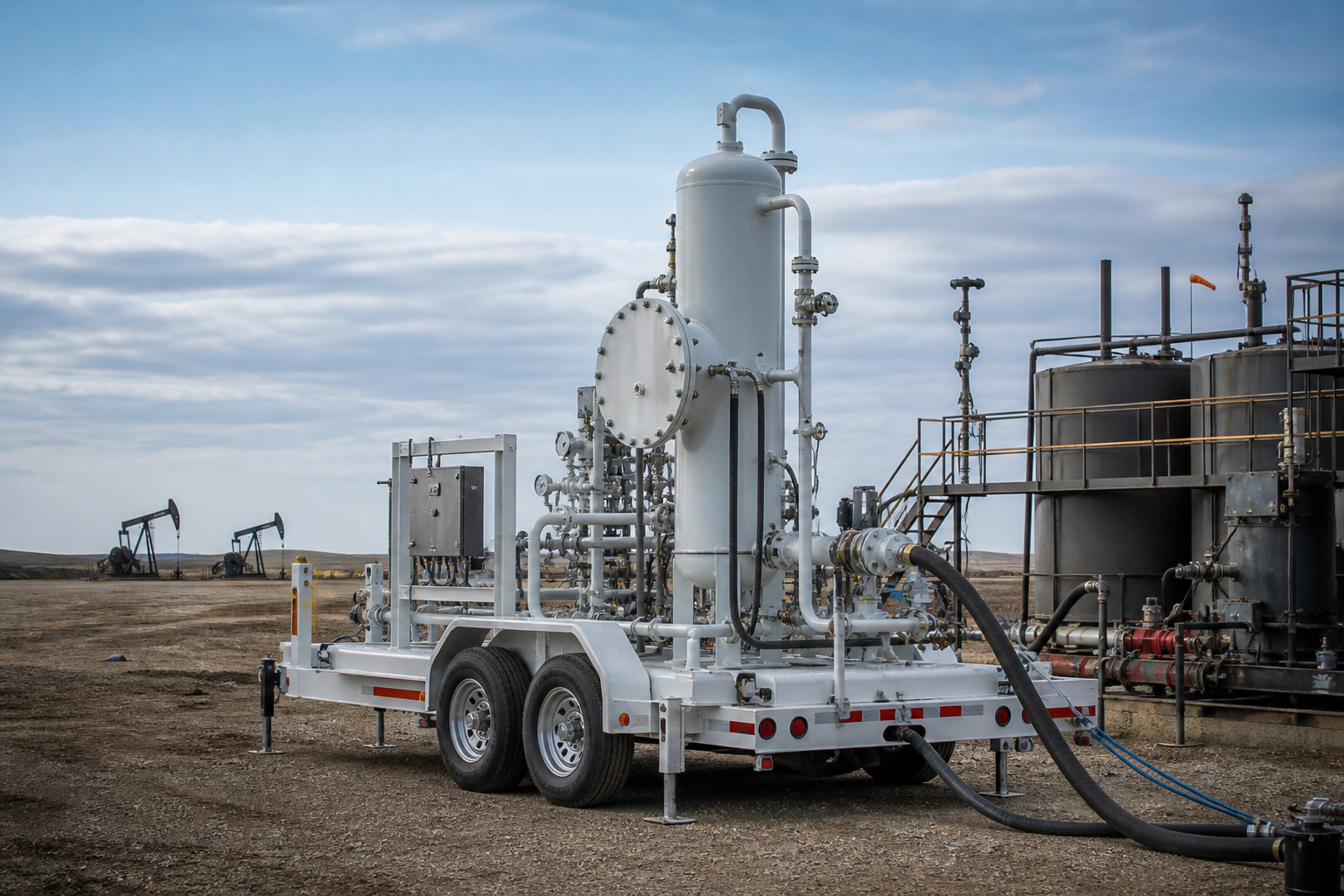
- Contactor Towers / Scrubbers — Highest efficiency. Ideal for consistent H₂S loads.
- Direct Injection — Lower capex but lower efficiency. Used for polishing or low-H₂S streams.
Recommended Applications
| Scenario | Preferred Scavenger | Reason |
|---|---|---|
| Standard water-based gas gathering, moderate H₂S (50–300 ppmv) | MEA Triazine | Lower cost per gallon, high active content, proven track record |
| Cold climates / winter operations | MMA Triazine | Lower freezing point, reduced need for heat tracing |
| Systems prone to solids/fouling or long pipelines | MMA Triazine | Oil-soluble byproducts minimize dithiazine precipitation |
| Environmentally sensitive areas or strict BTEX limits | MMA Triazine | BTEX-free formulation |
| High-volume, cost-sensitive operations | MEA Triazine | Better economics at scale; widely available |
| Heavy crude or low-water-content gas streams | MMA Triazine | Better compatibility with hydrocarbon phases |
Table 2: Decision matrix for selecting MEA vs MMA Triazine in natural gas service.
5. Benefits and Drawbacks
MEA Triazine
Advantages:
- Higher active concentration → more H₂S removal per gallon
- Generally lower purchase price per unit volume
- Fast reaction kinetics in optimal temperature range
- Industry standard with extensive field data and supplier support
- Excellent performance in water-dominated systems
Drawbacks:
- Byproduct can form solids, causing fouling in towers, valves, and pipelines
- Higher freezing point requires heat tracing in cold weather
- Trace BTEX may trigger environmental or worker exposure concerns
- Potential for increased corrosion from unreacted MEA
MMA Triazine
Advantages:
- Oil-soluble byproducts dramatically reduce solids and fouling risk
- Superior cold-temperature performance (lower freezing point)
- BTEX-free — preferred for regulatory compliance and HSE
- Documented long-term success (e.g., 13–17 years on North Sea platforms with fewer operational issues)
- More stable in variable conditions; less temperature-sensitive
Drawbacks:
- Lower active content means higher volume consumption for the same H₂S load
- Often higher cost per gallon of formulated product
- Slightly slower kinetics in some tower applications
- Less historical data in some regions compared to MEA
6. Cost Analysis and Economics
Cost is often the deciding factor. MEA Triazine generally offers better raw economics due to higher active content and broader manufacturing base.
Typical 2025–2026 market pricing (indicative):
- MEA Triazine 70–78%: $2.50 – $5.50 per US gallon (bulk)
- MMA Triazine 40%: $3.80 – $7.00 per US gallon (often premium for BTEX-free grade)
Cost per lb H₂S removed is frequently 15–35% lower for MEA Triazine in standard conditions. However, when factoring in downtime, pigging, solids disposal, and maintenance from fouling, MMA Triazine can deliver lower total cost of ownership in many real-world situations.
Real-World Example: On North Sea platforms, switching from MEA to MMA Triazine eliminated solids-related pigging and extended equipment life, resulting in net savings despite higher chemical purchase cost.
7. Environmental, Safety, and Operational Considerations
Both products are alkaline and require proper PPE. H₂S itself remains the primary hazard.
- Byproduct Management: Spent solutions contain dithiazines that are generally biodegradable but may require licensed disposal. MMA’s oil-soluble byproduct is easier to separate in desalter systems.
- BTEX & Emissions: MMA Triazine’s BTEX-free nature reduces fugitive aromatic emissions and simplifies permitting in sensitive areas.
- Corrosion: Both can contribute to overhead corrosion if over-injected; proper dosage control and monitoring are essential.
- Regulatory Trend: Increasing pressure on BTEX and solids discharge favors MMA Triazine in many jurisdictions.
Conclusion: Making the Right Choice
MEA Triazine remains the workhorse for cost-sensitive, high-volume natural gas sweetening where water-based systems dominate and solids management is manageable. Its high active content and proven economics make it the default choice for many operators.
MMA Triazine is rapidly gaining preference — and in many modern operations should be considered the primary option — due to its superior operational reliability, reduced fouling, better cold-weather performance, and environmental profile. Field data from long-term deployments consistently show fewer upsets and lower total lifecycle costs when solids or temperature challenges exist.
The optimal strategy for many operators is not either/or but a hybrid approach: use MEA Triazine in primary high-volume contactors and MMA Triazine for polishing, cold sections, or critical pipelines. Laboratory bottle tests, field trials, and H₂S mapping are strongly recommended before full-scale conversion.
As natural gas production shifts toward more remote, variable, and environmentally regulated assets, understanding these nuanced differences between MEA and MMA Triazine becomes essential for safe, efficient, and cost-effective H₂S management.