Article Content
This article examines their mechanisms, applications in oil and gas operations, comparative advantages and limitations, reaction products, and post-use disposal strategies. It draws on established engineering practices from refinery fuel gas treating, sour water stripper off-gas handling, and produced fluid management.
Chemical Reactions and Mechanisms
Both NaOH and KOH function as strong bases that rapidly neutralize H₂S in aqueous solution. The reactions occur in packed towers, venturi scrubbers, spray chambers, or via direct injection into pipelines or tanks.
For Sodium Hydroxide (NaOH)
H₂S + NaOH → NaHS + H₂O (sodium hydrosulfide formation, favored at moderate pH ~7–10 with near-stoichiometric dosing)
NaHS + NaOH → Na₂S + H₂O (sodium sulfide formation, favored with excess NaOH and pH >10)
Overall (excess caustic): H₂S + 2NaOH → Na₂S + 2H₂O
Stoichiometry requires approximately 1.17 g NaOH per gram of H₂S for NaHS or 2.35 g NaOH per gram of H₂S for Na₂S. Typical industrial solutions are 20–50 wt% NaOH.
For Potassium Hydroxide (KOH)
H₂S + KOH → KHS + H₂O
KHS + KOH → K₂S + H₂O
Overall: H₂S + 2KOH → K₂S + 2H₂O
Mass ratio is higher (~1.65 g KOH per g H₂S for KHS; ~3.29 g for K₂S) due to KOH’s higher molecular weight.
Key nuances: Reactions are extremely fast (seconds to minutes under good mixing) and exothermic. pH control is critical — moderate pH favors the hydrosulfide (more desirable for byproduct quality), while excess base drives full sulfide formation. Competing absorption of CO₂ (common in natural gas) consumes extra caustic and reduces H₂S selectivity. Mercaptans (RSH) may also react to form mercaptides.
Applications in Oil and Gas Operations
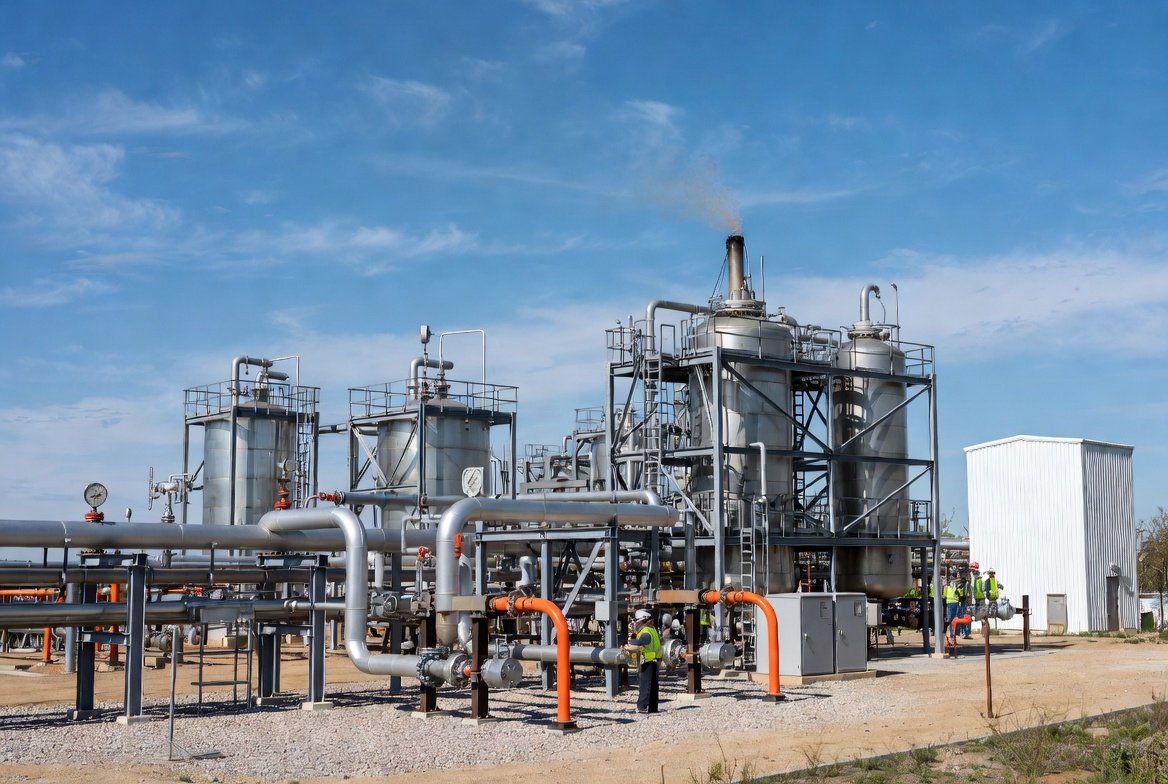
Caustic scrubbing excels in scenarios where regenerable amine systems or Claus sulfur recovery are uneconomical — low H₂S loads, intermittent flows, remote/offshore sites, or backup service.
Common uses include:
- Sweetening refinery fuel gas or hydrotreater off-gas
- Treating sour water stripper (SWS) overheads (often with ammonia co-removal via staged stripping)
- Direct injection into pipelines or produced water for odor/H₂S control
- Vent or flare gas polishing
- Mobile or skid-mounted units for short-term well testing or maintenance
Equipment ranges from simple single-loop recirculating packed towers (excess caustic for deep removal) to dual-loop systems (bulk removal in lower section, polishing with fresh caustic on top) and short-contact-time venturi or static-mixer designs for high CO₂:H₂S ratios. Both NaOH and KOH are dosed at 1.1–1.5× stoichiometric excess. NaOH dominates due to established infrastructure and byproduct markets; KOH sees niche use where potassium salts offer advantages.
Key Differences Between NaOH and KOH Chemistries
| Aspect | NaOH (Sodium Hydroxide) | KOH (Potassium Hydroxide) |
|---|---|---|
| Cost | 30–50% cheaper and widely produced | Premium pricing (more expensive) |
| Solubility & Handling | High solubility; standard 20–50% solutions | Higher solubility; dissolves with more heat; more hygroscopic |
| Byproduct Market Value | Strong, established market for NaHS (15–40% solutions) in pulp & paper, mining, tanning | Limited market for KHS/K₂S; harder to sell |
| Performance in O&G | Industry standard; excellent track record | Niche use only; similar effectiveness but less common |
| Best Suited For | Most oil & gas H₂S removal projects | Cases needing higher concentration or specific potassium chemistry |
Benefits and Drawbacks
NaOH Benefits
- Lowest operating cost for small-to-medium H₂S loads
- Extremely fast reaction kinetics (seconds to minutes)
- Potential revenue from selling high-quality NaHS
- Simple, low-capital equipment (skid-mounted or permanent)
- Proven across refineries and gas plants worldwide
NaOH Drawbacks
- Non-regenerable — high chemical consumption for sustained high loads
- Spent caustic is hazardous (pH >12, sulfides, possible phenols/mercaptans)
- CO₂ co-absorption increases consumption and degrades product quality
- Corrosion and safety risks (severe chemical burns)
- May require downstream pH adjustment
KOH Benefits
- Higher water solubility allows more concentrated solutions
- Comparable or slightly better performance in certain high-load scenarios
- Potassium salts may offer advantages in specific downstream processes
KOH Drawbacks
- Significantly higher chemical cost (often 30–50%+ more than NaOH)
- Limited or non-existent market for potassium sulfide byproducts
- Less operational experience and supplier support in oil & gas
- Same safety, corrosion, and CO₂ issues as NaOH
For loads above ~10 tons of sulfur per day, regenerable technologies (amines, liquid redox, biological) usually become more economical regardless of which base is chosen.
Reaction Products and Their Implications
Primary products are NaHS/Na₂S or KHS/K₂S — highly soluble, non-volatile salts that eliminate the immediate H₂S hazard and odor from the gas phase. With excess base, the solution remains strongly alkaline. Carbonates from CO₂ absorption dilute the sulfide product and may cause precipitation or scaling. Mercaptides add organic sulfur load.
These sulfides retain toxicity and oxygen demand; they cannot be discharged directly. The heat of reaction is exothermic (~14 kcal per mole of H₂S), so cooling is often required in high-load systems. Product quality (sulfide strength, low carbonate content) determines whether the spent solution can be sold.
Spent Caustic Management and Disposal
After use, the solution becomes “spent sulfidic caustic” (residual base + sulfides + carbonates + organics). It is classified as hazardous waste in most jurisdictions and requires careful handling.
Common strategies (applicable to both Na- and K-based systems, though NaHS has a much stronger market):
- Beneficial reuse / sale — High-quality NaHS is sold to pulp & paper mills, mining operations, and chemical manufacturers. K-based streams are usually treated instead.
- Wet Air Oxidation (WAO) — High-temperature/pressure process that converts sulfides to sulfate and destroys organics (50–95% COD reduction).
- Chemical oxidation — Hydrogen peroxide (with or without iron catalyst) or bleach rapidly oxidizes sulfides to sulfate on-site.
- Biological treatment — Specialized bacteria in fluidized-bed reactors degrade sulfides and mercaptans.
- Deep-well injection — Still used in some regions but facing increasing regulatory restrictions.
- Dilution into wastewater treatment — Only after partial treatment and for low-strength streams.
Disposal costs vary widely by location and volume. On-site treatment (WAO or H₂O₂) is often the most economical and compliant long-term solution.
Design, Economic, and Environmental Considerations
Successful caustic systems balance H₂S specification, sulfur throughput, CO₂ content, and spent-caustic fate. Dual-loop or short-contact-time designs minimize caustic consumption while achieving deep removal (<1–5 ppmv H₂S). Materials of construction must withstand hot concentrated caustic.
Economics favor caustic scrubbing for loads under ~10 tons of sulfur per day when NaHS can be sold or disposal costs are manageable. Capital cost is modest compared with amine or Claus plants. Environmental benefits include near-complete H₂S capture, but proper waste management is essential to avoid shifting the problem from air emissions to water or soil contamination.
Conclusion
Sodium hydroxide remains the predominant choice for caustic-based H₂S removal in oil and gas due to its favorable economics, established byproduct markets, and proven performance. Potassium hydroxide offers a viable alternative in specific scenarios where its higher solubility or potassium chemistry provides clear advantages, though higher costs and limited byproduct outlets restrict broader adoption.
Both deliver rapid, effective neutralization but generate spent sulfidic caustic that demands responsible management through sale, oxidation, or regulated disposal. As the industry pushes toward lower emissions and circular economy principles, optimized caustic designs combined with advanced oxidation or biological polishing will continue to play a vital role in safe, compliant sour gas handling — especially for smaller or variable loads where regenerable systems are impractical.