Article Content
Mass transfer is a fundamental process in chemical engineering that governs the movement of chemical species from one phase to another. In gas-liquid systems, it is critical for operations such as gas absorption, stripping, and reactive scrubbing. This article explores the core principles of mass transfer between liquids and gases, with a focus on bubble columns, which are widely used in industrial applications including natural gas sweetening, wastewater treatment, and chemical synthesis.
Fundamentals of Mass Transfer
Mass transfer occurs due to a concentration gradient and can happen via molecular diffusion, convection, or a combination of both. In gas-liquid contactors, the rate of mass transfer is described by the general equation: N_A = k * A * (C_i – C_b) Where N_A is the molar flux, k is the mass transfer coefficient, A is the interfacial area, and (C_i – C_b) is the concentration driving force between the interface and the bulk. Diffusion follows Fick’s Law: J = -D * ∇C, where D is the diffusivity. In turbulent systems, eddy diffusion enhances transport. For gases, diffusivities are higher than in liquids, making liquid-side resistance often dominant in absorption processes.Key Theories in Gas-Liquid Mass Transfer
Two-Film Theory
Proposed by Whitman in 1924, the two-film theory assumes stagnant films exist on both the gas and liquid sides of the interface. Mass transfer through these films occurs by molecular diffusion, with equilibrium at the interface governed by Henry’s Law: P = H * C, where H is Henry’s constant. The overall resistance is the sum of gas-film and liquid-film resistances: 1/K_G = 1/k_G + H/k_L For sparingly soluble gases like oxygen or H₂S in water-based systems, the liquid-film resistance dominates. This theory simplifies design but assumes steady-state linear gradients.Penetration and Surface Renewal Theories
Higbie’s penetration theory (1935) considers unsteady diffusion into fluid elements exposed to the interface for a short contact time t: k_L = 2 * sqrt(D / (π t)). Danckwerts’ surface renewal model improves this by assuming random surface renewal with rate s: k_L = sqrt(D * s). These models better account for turbulence and bubble motion in dynamic systems like bubble columns.Mass Transfer Coefficients and Interfacial Area
The volumetric mass transfer coefficient k_L a is a key design parameter, where a is the specific interfacial area (m²/m³). In bubble columns, a = 6 ε_G / d_{32}, with ε_G as gas holdup and d_{32} as Sauter mean bubble diameter. Factors influencing k_L a include:- Superficial gas velocity (U_G): Increases holdup and turbulence up to a point.
- Bubble size and distribution: Smaller bubbles provide higher area but may coalesce.
- Liquid properties: Viscosity, surface tension, density.
- Column geometry and internals.
Bubble Columns: Hydrodynamics and Mass Transfer
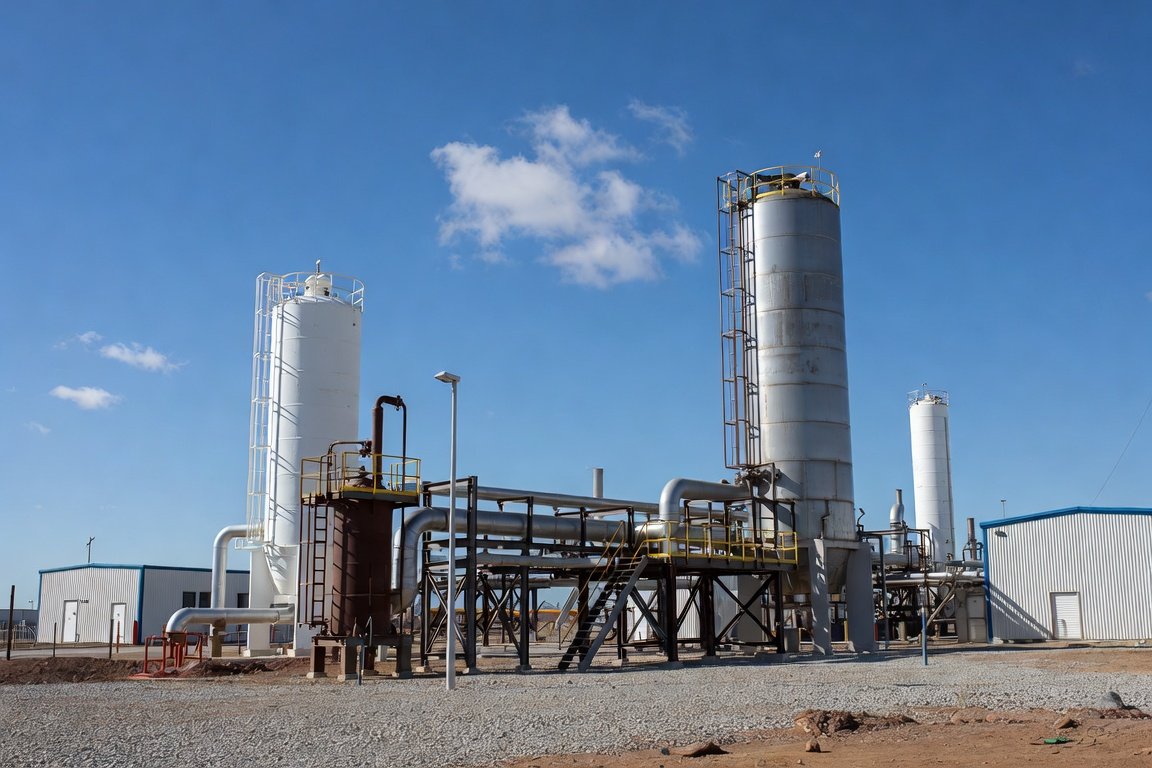
Bubble columns are vertical vessels where gas is sparged at the bottom through a distributor, rising as bubbles through a liquid (or slurry) phase. They offer simple construction, low energy input, and good mass/heat transfer, making them ideal for H₂S removal in natural gas sweetening using scavengers like triazines.Flow Regimes
– Homogeneous (Bubbly) Regime: Low U_G (< 0.03-0.05 m/s), uniform small bubbles, high interfacial area. – Heterogeneous (Churn-Turbulent) Regime: Higher U_G, larger bubbles, coalescence, recirculation. Mass transfer can be complex due to bubble size distribution. Transition depends on gas distributor, liquid properties, and pressure.Gas Holdup and Bubble Dynamics
Gas holdup ε_G increases with U_G and decreases with column diameter and liquid viscosity. It directly impacts interfacial area. Bubble rise velocity, shape (spherical to ellipsoidal to cap), and wake effects influence contact time and renewal rates.Mass Transfer in Bubble Columns for Gas Absorption
In absorption, gas solute transfers into liquid. For reactive systems like H₂S + scavenger, chemical reaction enhances mass transfer by consuming solute in the liquid film (Hatta number analysis). The enhancement factor E = k_L(reactive) / k_L(physical) can be significant. Design considerations:- Sparger design for fine bubbles (e.g., fritted glass or perforated plates).
- Column height for sufficient residence time.
- Pressure and temperature effects on solubility and kinetics.
- Scale-up challenges: Larger diameters promote recirculation, affecting uniformity.
Modeling and CFD Approaches
Modern design uses Computational Fluid Dynamics (CFD) with Euler-Euler or Euler-Lagrange methods coupled with population balance models (PBM) for bubble size distribution. Mass transfer models include single-bubble, slip velocity, or eddy-cell approaches. Improved models account for residence time distribution, bubble shape, and swarm effects for better prediction across regimes.Applications and Industrial Relevance
Bubble columns are used in:- Natural gas sweetening (H₂S removal).
- Fermentation and bioreactors (oxygen transfer).
- Wastewater aeration.
- Carbon capture and chemical production.