Article Content
Liquid chemical scavengers, particularly triazine-based formulations, are a popular non-regenerative method for removing low-to-moderate levels of H₂S directly in pipelines. However, the efficiency of this process depends heavily on how the H2S scavenger is introduced into the gas stream. Atomizers play a pivotal role by maximizing contact between the liquid scavenger and the gaseous H₂S.
The Challenges of Direct Injection of H2S Scavenger without Atomization
Simple quill or drip injection introduces scavenger as relatively large streams or droplets. In a high-velocity gas pipeline, these larger droplets have limited surface area and tend to coalesce, fall out of suspension, or wet only portions of the pipe wall. This results in poor gas-liquid contact, incomplete reaction, and the need for higher chemical dosages—often 2-3 times more than optimized systems—to achieve the same H₂S removal.
Without proper dispersion, much of the scavenger may not encounter H₂S molecules effectively within the available residence time (typically determined by pipeline length and flow velocity). Operators face increased costs, potential under-treatment leading to off-spec gas, and risks of liquid accumulation causing operational issues like slugging or corrosion hotspots.
The Role of Atomizers: Maximizing Interfacial Area and Mass Transfer
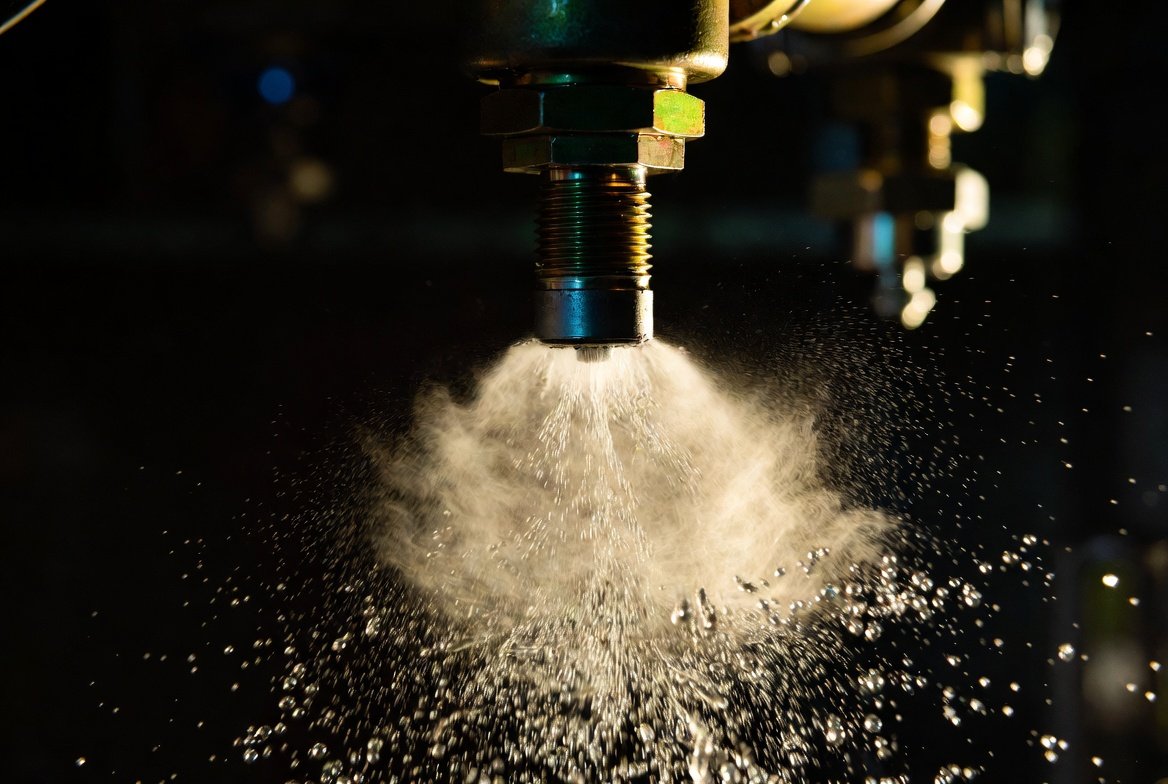
Atomizers break the liquid scavenger into thousands or millions of fine droplets, creating a mist or fog that disperses throughout the gas stream. This dramatically increases the gas-liquid interfacial area—the key driver of mass transfer efficiency.
Basics of Mass Transfer in H₂S Scavenging
Mass transfer in this context involves H₂S diffusing from the bulk gas phase to the surface of scavenger droplets, absorbing into the liquid, and reacting chemically (e.g., with triazine to form stable, non-toxic byproducts). The overall rate is governed by the two-film theory, where resistance exists in both gas and liquid films at the interface.
The volumetric mass transfer rate can be expressed as:
N = K_L a (C^* - C)
Where:
Nis the molar flux of H₂S,K_Lis the overall liquid-side mass transfer coefficient,ais the specific interfacial area (area per unit volume),C^*andCare equilibrium and bulk concentrations.
Atomization primarily boosts a by reducing droplet size. The Sauter Mean Diameter (SMD or D32) is a critical metric—it represents the diameter of a droplet with the same volume-to-surface area ratio as the entire distribution. Smaller SMD values yield exponentially higher surface area for the same liquid volume (since area scales with the square of diameter, while volume scales with the cube).
For example, reducing droplet diameter from 500 μm (typical of poor injection) to 100-150 μm can increase interfacial area by roughly 3-5 times or more, accelerating reaction kinetics and allowing shorter contact lengths or lower dosages.
Gas velocity, turbulence, and pipeline geometry further influence droplet dispersion and residence time. In low-velocity or large-diameter lines, atomization is especially crucial to prevent settling.
Types of Atomizers and Nozzles for Scavenger Injection
Several atomizer designs are used in natural gas pipelines:
1. Hydraulic (Pressure) Atomizers
These rely solely on liquid pressure to break up the stream. Common spray patterns include full-cone (for broad coverage) and hollow-cone. They are simple, require no auxiliary gas, and perform well in high-pressure pipelines (500–1500 psig). Typical SMD: 100–250 μm. Brands like BETE WhirlJet or Spraying Systems nozzles are widely used.
2. Twin-Fluid (Air/Gas-Assisted) Atomizers
These use compressed air, nitrogen, or steam alongside the liquid for finer atomization, achieving SMD as low as 30–100 μm even at lower liquid pressures. Ideal for low-velocity flows or applications needing ultra-fine mists. They offer superior dispersion but require an additional gas supply.
3. Specialized Inline Atomizers and Lances
Devices like ProSep eCLIP or custom lances integrate atomization with enhanced mixing. These can achieve pipeline specs in very short distances (e.g., <12 ft vs. 250+ ft for standard quills) by optimizing droplet distribution and turbulence.
Selection depends on factors such as gas flow rate, pressure drop availability, pipeline diameter, H₂S concentration, scavenger viscosity, and required residence time. Nozzle sizing must balance flow rate with droplet size—oversized nozzles produce coarser sprays, while undersized ones risk clogging or excessive pressure requirements.
Benefits of Proper Atomization
- Higher Efficiency and Lower Chemical Consumption: Up to 10x more interfacial area leads to 15–30% or greater reductions in scavenger usage.
- Faster Reaction: Achieves spec H₂S levels in shorter pipeline segments, reducing the need for long straight runs.
- Better Pipe Wall Wetting: In stratified or low-flow conditions, fine droplets help distribute scavenger evenly, mitigating localized corrosion.
- Reduced Operational Issues: Less liquid dropout minimizes pooling, fouling, and maintenance. Proper atomizers also help prevent nozzle clogging when using formulations prone to solids (e.g., certain MEA-triazines).
- Cost Savings: Lower chemical costs, reduced pump wear, and extended asset life translate to significant OPEX reductions.
Practical Considerations for Implementation
Effective systems require more than just a good nozzle. Key elements include:
- Injection Location: Upstream of sufficient straight pipe for mixing and reaction time.
- Static Mixers or Coils: Often paired with atomizers for enhanced turbulence.
- Monitoring and Control: Inline H₂S analyzers before and after injection points for real-time optimization of dosage.
- Maintenance: Regular inspection for plugging; use of filters and compatible materials.
- Modeling: CFD simulations and empirical models help predict performance based on flow conditions, droplet trajectories, and mass transfer coefficients.
Operators should conduct field trials comparing atomized vs. non-atomized injection to quantify benefits specific to their conditions.
Alternatives and When Atomization May Be Less Critical
In very high-velocity, long pipelines with high turbulence, even quill injection may suffice due to natural dispersion. However, for most midstream applications, atomization provides superior economics and reliability. For higher H₂S loads, contact towers or regenerative systems (e.g., amines) may be more suitable, though they involve higher CAPEX.
Emerging scavengers with better dispersion properties or lower molecular weights can complement atomization for further optimization.
Conclusion
Atomizers transform H₂S scavenger injection from a crude dosing exercise into a precise, efficient mass transfer process. By generating fine droplets that maximize interfacial area, they ensure rapid and thorough reaction between scavenger and H₂S molecules in the dynamic pipeline environment. This leads to lower chemical consumption, faster achievement of specifications, reduced corrosion risks, and overall improved economics for natural gas producers and midstream operators.
Selecting the right atomizer type, nozzle design, and integration strategy—tailored to specific operating parameters—is essential for success. As regulations tighten and cost pressures mount, optimized atomized injection will remain a cornerstone of cost-effective sour gas treatment.