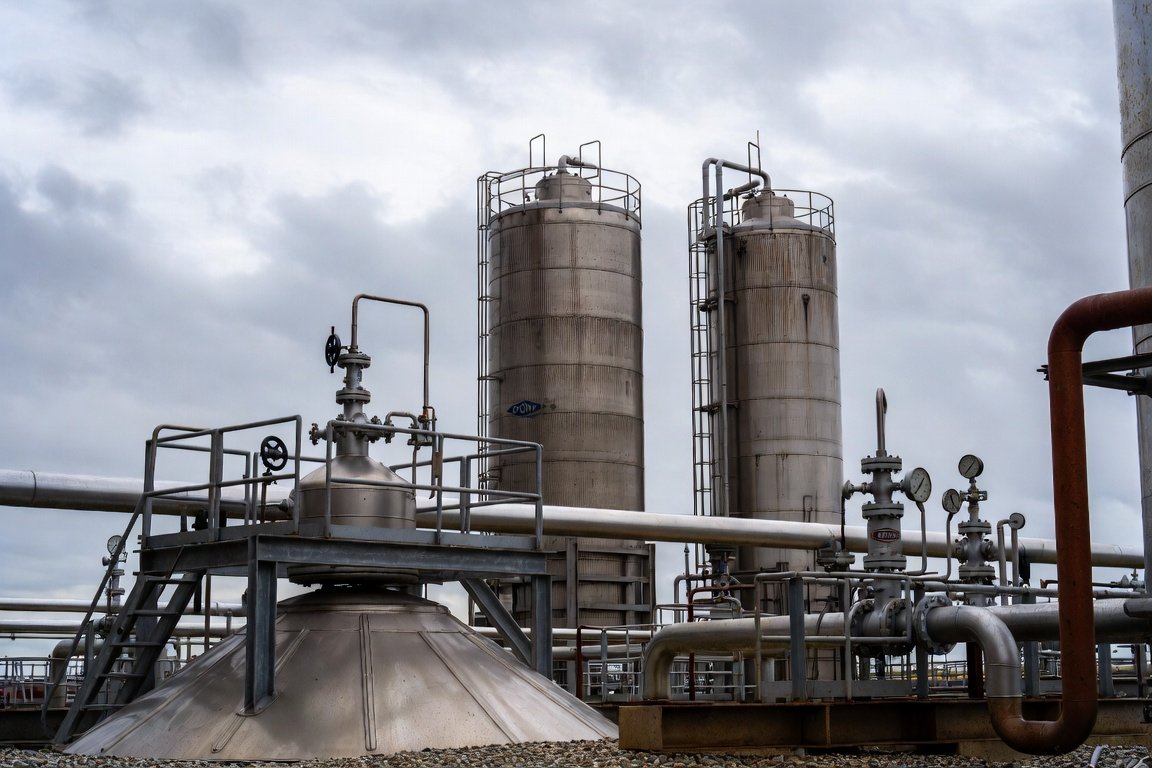
Sour water stripping is one of the most important, and most frequently underestimated, hydrogen sulfide (H2S) management operations in refineries, upgraders, gas plants, and integrated oil sands facilities. Unlike produced-water treating, which addresses formation water brought up with hydrocarbons, sour water stripping deals with process-generated aqueous streams that have absorbed H2S, ammonia (NH3), and related contaminants in distillation, hydroprocessing, coking, and amine units. If these streams are not stripped properly, H2S reports to sewers, storage tanks, and reuse circuits, creating odor, corrosion, and personnel-exposure hazards that no downstream water-treatment chemistry can fully correct.
What Sour Water Is and Where It Comes From
Sour water is process water that contains dissolved H2S, NH3, and often phenols, cyanides, mercaptans, carbon dioxide, and emulsified hydrocarbons. The dominant dissolved species is ammonium bisulfide, NH4HS, formed when H2S and NH3 dissolve together:
H2S (aq) + NH3 (aq) ↔ NH4+ + HS−
That equilibrium is the reason sour water is both a safety problem and a stripping problem. At the pH typical of refinery sour water (approximately 7.5 to 9.5), a large fraction of the sulfide is present as HS− rather than molecular H2S. Steam stripping must reverse the equilibrium, driving molecular H2S and free NH3 into the vapor phase so they can be removed overhead.
The main sources are crude and vacuum distillation overhead water; wash water from hydrotreaters, hydrocrackers, and hydrodesulfurization units; delayed-coker and visbreaker sour water; fluid catalytic cracker (FCC) fractionator water; and amine-unit reflux and flash-drum water. Distillation overhead water may contain tens to a few hundred parts per million of H2S. Hydrotreater and coker waters commonly contain 1,000 to 15,000 ppm H2S and comparable or higher NH3. Cyanide and phenol loads are highest in FCC and coker waters, which is why those streams often need dedicated pretreatment. The H2S:NH3 molar ratio controls both stripping difficulty and overhead-gas quality: H2S-rich feeds produce a more acceptable Claus feed, while NH3-rich feeds usually require a dedicated ammonia-destruction burner or a two-stage stripper that splits the two gases.
How Sour Water Stripping Removes H2S
A sour water stripper (SWS) is a distillation-type column that uses steam as the stripping medium. Sour water is preheated against hot stripped water, then fed to the upper section of a trayed or packed tower. Steam, either injected live or generated in a reboiler, flows upward. The rising vapor reduces the partial pressure of H2S and NH3 above the liquid, and both species transfer into the vapor according to their vapor-liquid equilibria. Stripped water leaves the bottom. The overhead vapor — steam, H2S, NH3, and residual hydrocarbons — is partially condensed or sent forward as a wet acid-gas stream.
Two design families dominate industrial practice. Single-stage stripping uses one column to remove both H2S and NH3 into a combined overhead. It is simpler, cheaper, and adequate when the overhead can be incinerated, routed to a flexible sulfur plant, or treated in a dedicated off-gas scrubber. Residual H2S in the stripped water is typically specified at less than 10 ppm, and residual NH3 at 30 to 100 ppm. Two-stage stripping uses two columns in series. The first operates at higher pressure and a relatively low steam rate so that H2S is preferentially stripped while most of the NH3 remains in the liquid, producing an H2S-rich Claus feed. The second column then strips the remaining NH3 and residual H2S at lower pressure with more steam; that ammonia-rich overhead is usually incinerated or sent to ammonia recovery. Two-stage designs are justified when Claus feed quality or ammonia management is the binding constraint.
The driving force for H2S removal is not simply temperature. It is the combination of temperature, pressure, steam-to-water ratio, and liquid pH. Raising temperature favors the molecular (volatile) forms of both H2S and NH3. Lowering pressure increases the vapor mole fraction of the acid gases at a given steam rate. If the feed is too alkaline, HS− dominates and H2S will not leave the liquid no matter how much steam is applied. In that case a small acid injection, or simply avoiding caustic contamination of the sour-water collection system, is more effective than adding reboiler duty.
Stripper Design and Typical Operating Conditions
Most industrial sour water strippers are trayed columns with 20 to 40 valve or sieve trays. Feed is usually introduced several trays below the top so that a rectifying section can knock water back into the column. Typical operating windows for a single-stage unit are a tower-top pressure of about 0.7 to 1.5 barg, a bottoms temperature of 115 to 135 °C, an overhead-accumulator temperature of 82 to 90 °C, and a stripping-steam rate of 0.10 to 0.25 kg steam per kg of feed water. The overhead accumulator should not be operated much below about 82 °C. Cooler overheads allow ammonium hydrosulfide and ammonium carbonate salts to deposit in condensers, reflux lines, and the top of the column — one of the most common causes of unplanned SWS shutdowns.
Parameter
Single-Stage SWS
Two-Stage SWS (H2S / NH3 columns)
Primary objective
Combined H2S and NH3 removal
H2S-rich Claus feed plus separate NH3 stream
Typical top pressure
0.7-1.5 barg
~4 barg / 0.5-1.0 barg
Bottoms temperature
115-135 C
120-140 C / 110-125 C
Steam rate
0.10-0.25 kg/kg feed
Lower on H2S column; higher on NH3 column
Stripped-water H2S
below 10 ppmw
below 1-10 ppmw
Stripped-water NH3
30-100 ppmw
below 10-50 ppmw
Preferred overhead destination
Incinerator, caustic scrubber, or flexible SRU
Claus plant and incinerator or NH3 recovery
Materials of construction are selected for wet H2S service and ammonium bisulfide corrosion. Carbon steel with a corrosion allowance is still common on the column shell when velocities are moderate and cyanide is low. Overhead condensers, reflux piping, and the top trays see the most aggressive NH4HS corrosion and are frequently upgraded to duplex stainless steel, Alloy 825, or titanium. Cyanide removes the protective iron sulfide film, so cyanide-rich FCC and coker waters should be segregated or pretreated. Feed preparation determines reliability more than internals do. Free oil, iron sulfide solids, and coke fines deposit on trays, foul reboilers, and stabilize foams. Standard practice is to collect sour waters in a degassing and surge drum, skim oil, and filter or coalesce hydroprocessing and coker waters before the stripper. Flash gas from a sour-water surge tank can contain several percent H2S and must be collected in a closed system.
Treating Sour Water Stripper Overhead Gas
Removing H2S from the water is only half of the job. The stripper overhead is a wet, corrosive, NH3-bearing acid gas that must be disposed of or converted to sulfur. The correct destination depends on H2S concentration, NH3 content, flow rate, and the receiving unit’s tolerances.
Overhead treating option
Best fit
Typical treated-gas H2S
Main limitations
Claus sulfur recovery unit
H2S-rich, NH3-lean overhead
Converted to sulfur; tail gas polished in a TGTU
NH3, hydrocarbons, and cyanides degrade Claus catalyst
Amine absorber
Dilute overhead that needs concentrating before Claus
Often below 10 ppmv in the sweet gas
NH3 contamination of amine; extra regenerator load
Caustic (NaOH/KOH) scrubber
Small to medium overheads and plants without an SRU
below 4 to 10 ppmv with excess caustic
CO2 consumes caustic; spent sulfide brine disposal
Liquid redox (chelated iron)
Moderate sulfur loads (about 0.2 to 20 t/d)
Typically below 10 ppmv
Higher capital cost; solution and sulfur handling
Liquid H2S scavenger
Low-rate vents, tank flash gas, temporary operation
Often below 10 ppmv
Not economical at continuous high sulfur loads
Thermal oxidizer / incinerator
NH3-rich second-stage overhead or small single-stage units
H2S destroyed; SO2 must meet stack limits
Creates SO2 and NOx; no sulfur recovery
For many mid-size gas plants and upgraders that do not operate a Claus unit, a recirculating packed-tower caustic scrubber on the SWS overhead is the practical H2S removal step. Dual-loop caustic contactors reduce chemical consumption when CO2 is also present. Liquid redox processes occupy the middle ground: they accept a wider H2S range than scavengers and produce elemental sulfur rather than a sulfide brine. Liquid scavengers remain appropriate for low-flow flash gas from sour-water tanks, truck-loading vents, and maintenance bypasses, but they are a poor substitute for a properly designed overhead treating system on a continuously operating stripper. Stripped water is commonly reused as desalter wash water, with typical targets of less than 10 ppmw H2S and 50 to 100 ppmw NH3. If stripping is incomplete, remaining H2S re-evolves in downstream tanks and sewers, which is why a poorly operated SWS shows up as odor at the API separator rather than as an alarm on the stripper itself.
Operating Problems and Technology Selection
The most frequent causes of high residual H2S in stripped water are insufficient steam, feed that is too alkaline, hydrocarbon flooding of trays, and salt deposition that takes trays out of service. Low steam or low bottoms temperature leaves both H2S and NH3 high. High pH from caustic contamination leaves H2S high while NH3 may still strip. Fouled trays produce a sudden loss of both specifications. Salt deposition, driven by an overhead that is too cold, plugs the top of the column and the condenser. Foaming is promoted by hydrocarbons and fine solids; antifoam is a short-term fix, while feed coalescing is the durable one. Air leakage into the collection system converts dissolved sulfide to elemental sulfur and thiosulfate, which foul the stripper.
Technology selection should treat the stripper as a system: collection, feed preparation, the column, overhead treating, and stripped-water destination. A large refinery with a Claus unit and significant ammonia generally justifies two-stage stripping. A site with modest ammonia can send a single-stage overhead to Claus if oil removal is adequate. A gas plant without a sulfur recovery unit typically pairs a single-stage SWS with a caustic scrubber, a liquid redox unit, or a thermal oxidizer. Low continuous sulfur loads, tank flash gas, and temporary well-test or turnaround bypasses are better served by a liquid scavenger or a mobile liquid-scrubber package. Incomplete stripping shifts sulfur into sewers and tanks, where it is then treated at much higher cost. The specification should be set by the next destination of the water and of the overhead, not by a generic “as low as possible” target.
Conclusion
Sour water stripping is a dedicated H2S and ammonia removal process, not a generic wastewater treatment step. It works by reversing the NH4HS equilibrium with steam in a trayed or packed column, producing a stripped water that can be reused or discharged and an overhead acid gas that must be converted, scrubbed, or destroyed. Single-stage units are appropriate where a combined H2S/NH3 overhead can be handled; two-stage units are justified when Claus feed quality or ammonia management is the binding constraint. Reliability depends less on exotic internals than on feed oil removal, overhead-temperature control to avoid ammonium-salt deposition, correct pH, and a deliberately chosen overhead-treating path. When those pieces are in place, a sour water stripper is one of the most cost-effective H2S removal units in the facility.